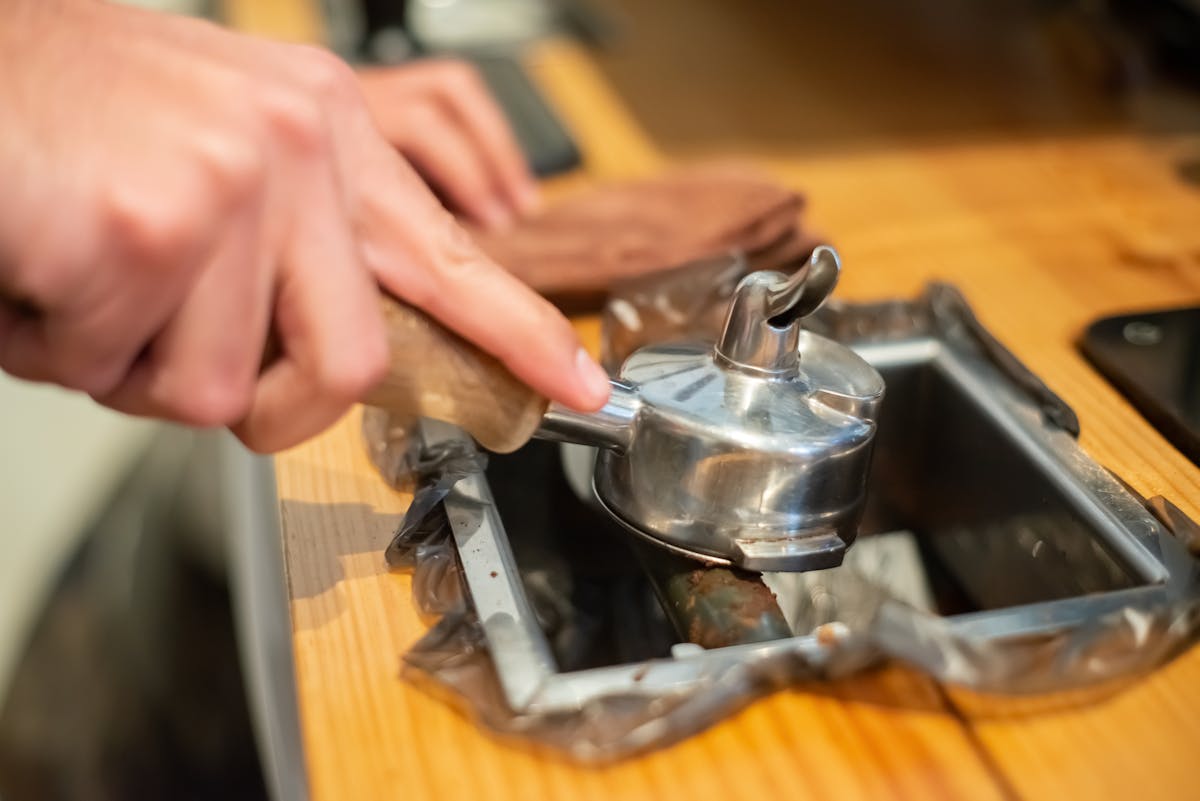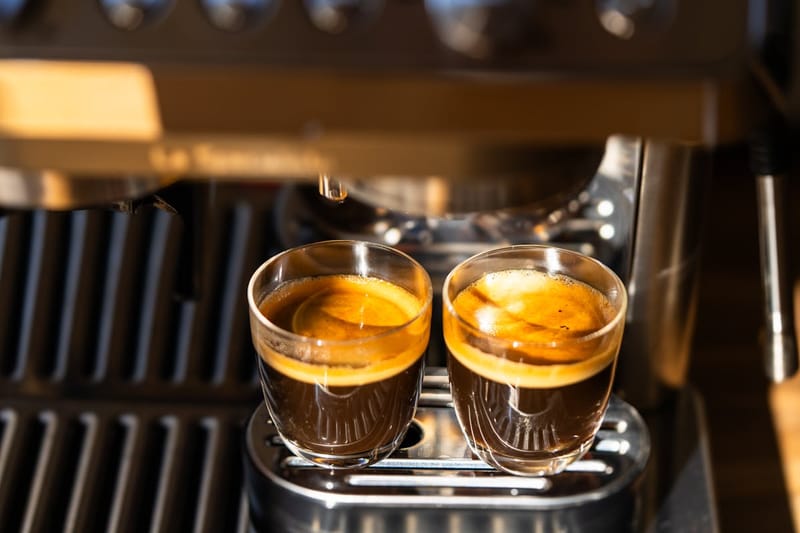
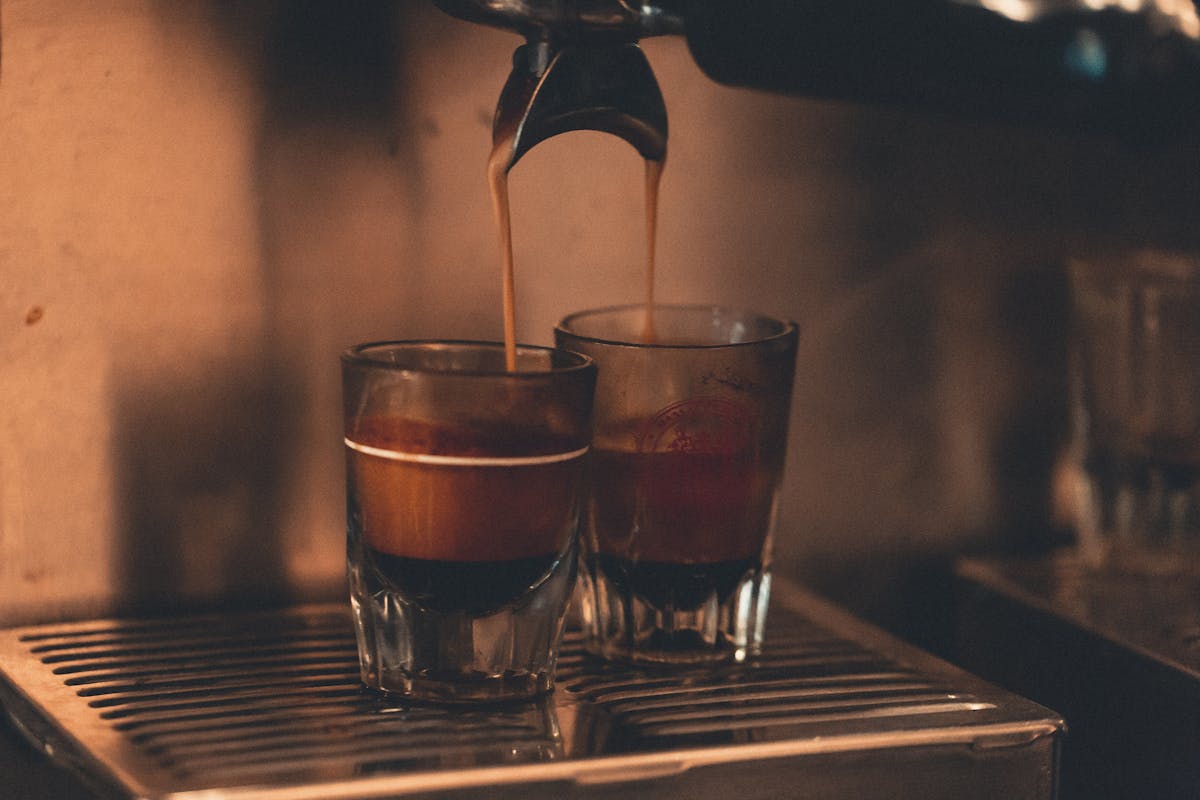
There is a moment, in the morning, when everything stops. The water heats up. The grinder turns. The powder falls into the portafilter, fine and even. You tamp, you lock in, and for twenty-five seconds, a thin stream of brown coffee flows into the cup, topped with a golden crema that will vanish before you’ve finished looking at it.
Espresso is a ritual of pressure and precision. Nine bars push water at 93 degrees through a puck of finely ground coffee. Too fast, and it’s acidic and hollow. Too slow, and it’s bitter and dry. The sweet spot comes down to the gram on the dose, the degree on the temperature, the tenth of a second on extraction time. What looks simple is in reality one of the most demanding gestures in everyday cooking.
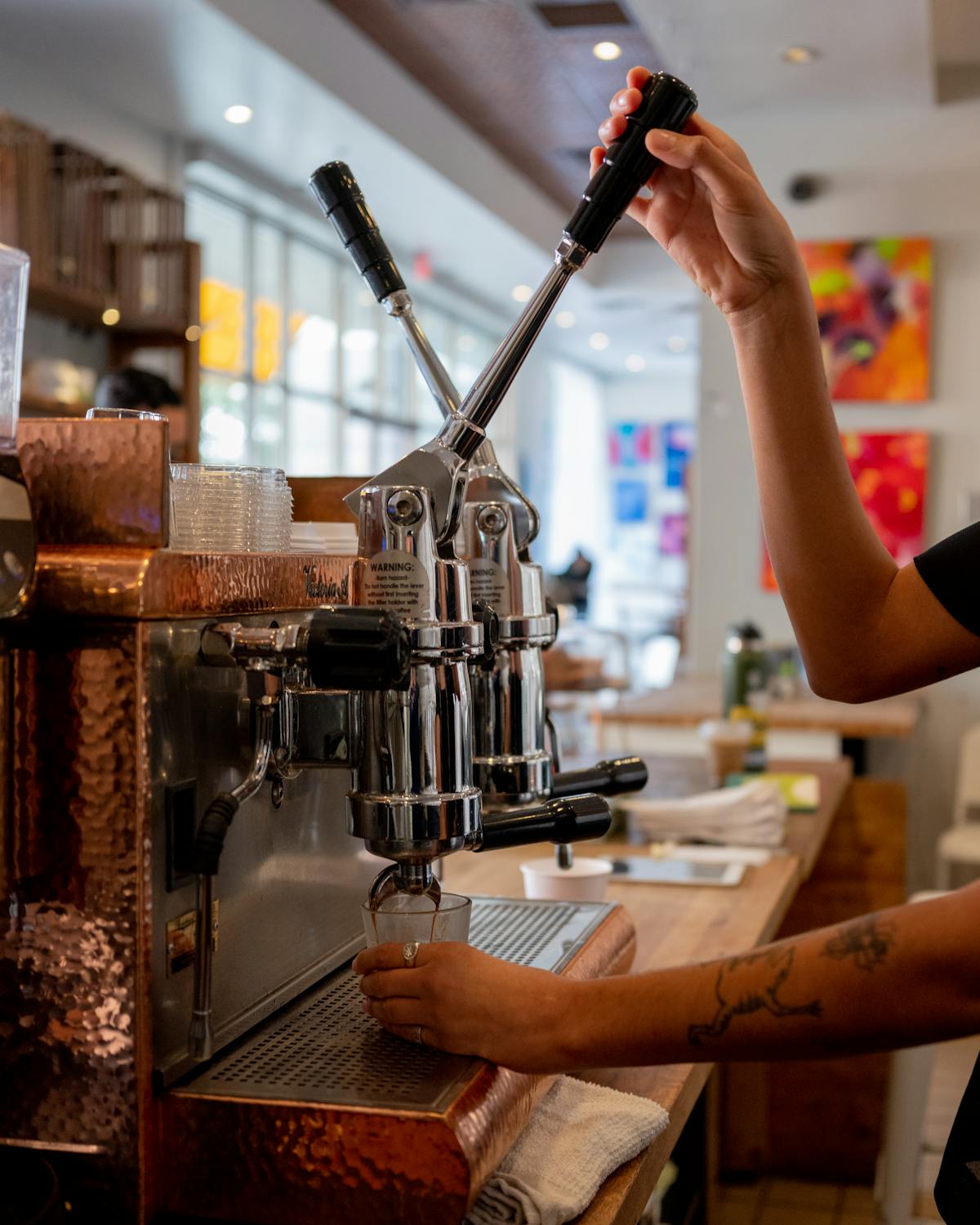
And behind that gesture, there are machines. Real ones. Built by families, engineers, and enthusiasts who have been making the same object for decades. This guide is their portrait. Thirteen brands, from Milan to Heidelberg, from Florence to a British garage. And a buying guide to find the machine that fits you.
The artisans of espresso
Bezzera — since 1901, the first
Bezzera invented everything. Luigi Bezzera filed his patent on 19 December 1901 in Milan: a machine with a removable portafilter, the direct ancestor of every espresso machine in the world.
A hundred and twenty-five years later, it is the fourth generation of the family at the helm, with Luca Bezzera in charge. The brand doesn’t make noise. No flashy Instagram campaigns, no World Barista Championship sponsorships. Just machines built by hand in Milan, in a workshop where the AISI 304 stainless steel body is assembled around copper boilers — a material Bezzera prefers over stainless steel for its superior heat retention.
The domestic range starts with the New Hobby, a small heat exchanger at around 800 euros, which honestly does the job for a first serious setup. But it is the Matrix that embodies the house’s current expertise: dual boiler, PID, control screen, direct water connection or reservoir. A semi-professional machine that needs no flashy logo because it descends in a direct line from the 1901 patent. Above 3,000 euros, the Arcadia borrows from the brand’s professional machines an architecture designed for throughput, adapted for the home.
A company with nothing left to prove, because it invented everything.
ECM and Profitec — the rigour of Bammental
ECM Manufacture and Profitec are sister companies, both led by Michael Hauck from Bammental, near Heidelberg. ECM was founded in 1996 by Wolfgang Hauck, and Profitec has existed since 1985. Two brands, one workshop, one family. The obvious question: why two?
The answer lies in positioning. ECM embodies the clean line, refined European design, the aesthetic choice. Profitec plays the card of pure functionality, the working tool. It isn’t a duplication: it’s the luxury of independence — being able to address two markets without a board of directors asking to “rationalise the portfolio”.
All machines use the E61 group, an industrial standard invented by Faema in 1961 that has become universal. The advantage: parts are interchangeable, accessories are compatible across brands, and any technician knows how to service them. It is the opposite of planned obsolescence.
ECM’s Synchronika II is their flagship: dual boiler, PID, a heat-up time of 15 to 30 minutes depending on the target temperature, and lines of a sobriety that contrasts sharply with Italian exuberance. On the Profitec side, the Drive (successor to the Pro 700) pushes further: OLED screen, flow control paddle integrated as standard, programmable pre-infusion with flow profiles. The key difference: the Profitec Drive offers pressure profiling natively, where the ECM Synchronika requires a separate kit. For anyone who wants to play with pressure, that matters.
These are machines you repair, keep, and pass on. The brushed stainless steel from Bammental knows no trends.
Rocket Espresso — Milanese style, born from a gamble
Rocket Espresso has only existed since 2007, but its story is already a legend. Andrew Meo and Jeff Kennedy, two New Zealanders, and Daniele Berenbruch, son of Friedrich Berenbruch — the partner of ECM’s Italian division — bought out ECM Italy’s struggling domestic production and rebranded it Rocket Espresso Milano.
The bet paid off beyond all expectations. With nearly 300,000 followers on Instagram, Rocket has turned the espresso machine into an object of desire. The Appartamento, with its copper and wood accents on a compact body, has become the archetype of the “Instagrammable” machine that also makes great coffee. It’s an honest heat exchanger at around 1,500 euros that does the job for most enthusiasts.
But it is the R Nine One that puts Rocket in another league. Forget the E61 group: here it’s a saturated group, the same principle as professional coffee machines, where the massive metal of the group is kept permanently at extraction temperature. The rotary gear pump is virtually silent and allows real-time pressure profiling via a touchscreen. The most spectacular feature: you can draw a pressure profile manually with the lever, save it, and reproduce it automatically the next morning without thinking about it. Its only comparable competitor, the La Marzocco GS3, cannot do that. Expect around 4,000 euros. The cool-touch steam wands prevent burns — a detail that shows Rocket thinks about daily use, not just the spec sheet.
Nuova Simonelli — independence through management
Nuova Simonelli has a singular story. Founded in 1936 by Orlando Simonelli in Tolentino, in the Marche region, the company changed hands in 1972, one year after the founder’s death on 9 May 1971. Not a takeover by a group: a management buyout led by four employees — Ottavi, Boldrini, Feliziani and Gesuelli — who pooled their savings to take over the company where they worked. It is their families who still run things today, under the presidency of Nando Ottavi. Fifty-four years of independence, won from the ground up.
The group (Simonelli Group S.p.A.) also owns Victoria Arduino, a luxury machine brand founded in 1905, whose Eagle One and Black Eagle equip high-end counters worldwide. They acquired a stake in 3TEMP (Sweden) in late 2024. Present in 121 countries, it is a heavyweight of professional coffee. Their Aurelia Wave is the official machine of the World Barista Championship.
For the home, the Oscar II remains a solid option at around 1,000-1,500 euros, with a distinctive feature: Nuova Simonelli doesn’t use the standard E61 group but a thermosyphon group of their own design. The portafilter remains the standard 58mm (compatible with all accessories on the market), but the water circulation is different. The result in the cup: a dense, syrupy espresso with plenty of body. The design, however, is a matter of debate: where the competition goes for the retro-industrial look, the Oscar II has rounded lines that divide opinion. But a machine should be judged in the cup, not in a design magazine.
Eureka — a hundred years of burrs, one family
Eureka does only one thing: coffee grinders. Since 1920. Founded in Florence by Aurelio Conti, the company is still in the hands of the Conti family, with 100% of manufacturing in Sesto Fiorentino, on the outskirts of Florence. Over a century doing nothing else but machining burrs and assembling grinders. There is something reassuring about that.
The choice between a Eureka grinder and a conical burr grinder like the Niche isn’t a question of quality: it’s a question of flavour profile. The flat 55mm steel burrs of the Mignon Specialità produce a grind that favours clarity and separation of notes. You taste the lemon acidity distinctly, the caramel sweetness, the floral hint. It is the grinder for fans of light roasts and straight espresso, without milk. The die-cast aluminium housing is dense and compact, the patented anti-clumping system prevents lumps, and the noise level of the “Silenzio” range is remarkably low for a flat burr grinder.
The proliferation of sub-models can be confusing: Crono (entry-level, no timer), Notte (quiet, no screen), Facile (mechanical timer), Specialità (digital timer, touchscreen), Oro (larger burrs), Turbo (faster burrs). But each variant targets a specific use. The Specialità at around 500 euros has become the default recommendation of the espresso community, and that is no accident. Retention is about 0.5 grams — acceptable for hopper use, a touch high for pure single-dosing.
Niche Coffee — the single-dose pioneer
Niche Coffee is the youngest brand in this guide, and the one that has shaken up the market the most. Founded in the United Kingdom by Martin Nicholson and his son James, the company raised over 5.5 million dollars on Indiegogo between 2017 and 2020. Their idea: a single-dose grinder with near-zero retention for the home.
To understand why that matters: before the Niche Zero, a quality single-dose grinder meant the Kafatek Monolith at over 1,200 euros, or a modified commercial grinder. Niche democratised the concept. You weigh your dose (typically 18 grams), pour it into the grinder, grind, and virtually nothing remains inside: around 0.1 grams of retention. Zero waste, zero cross-contamination between one day’s coffee and the next.
The Zero uses 63mm Mazzer Kony conical burrs, the same as in professional grinders costing 1,500 euros and up. Conical burrs produce a different flavour profile from Eureka’s flat burrs: more body, texture, chocolate notes. It is the grinder for latte art enthusiasts and medium-to-dark roasts. 171,000 Instagram followers for a company of a few dozen people is phenomenal. The Duo, released in 2023 with 83mm flat burrs, offers espresso-and-filter versatility for those who want flat-burr clarity with the convenience of single-dosing.
Production is in China (under Martin Nicholson’s direct supervision), which rubs some purists the wrong way at a price of 630 euros. And competitors have rushed into the gap: DF64, Turin, Fellow Opus, Option-O all offer convincing single-dose grinders. But the pioneer’s merit stands. Niche changed the way an entire generation grinds its coffee.

Understanding your machine: the espresso glossary
Before we talk budgets, a few concepts that change everything.
Heat exchanger (HX) vs dual boiler (DB). This is the fundamental choice. A heat exchanger uses a single boiler maintained at steam temperature (around 125°C). A tube runs through that boiler and brings the brew water to the right temperature (~93°C) on its way through. It’s elegant, it’s cheaper, and it produces powerful steam. But after a period of inactivity, you need to flush the group to prevent overheated water from scorching the coffee. And brew temperature is less precise, especially on back-to-back shots.
A dual boiler means two separate tanks: one for coffee, one for steam. Each has its own PID (temperature controller). You can brew and steam milk at the same time, without compromise. No flush needed. Superior thermal stability across consecutive shots. The downside: it’s more expensive (500-1,000 euros more at a comparable level), heat-up time is longer, and there are more components to maintain.
In short: heat exchanger for cappuccino lovers pulling 2-3 coffees per session; dual boiler for thermal-stability obsessives and those who entertain guests.
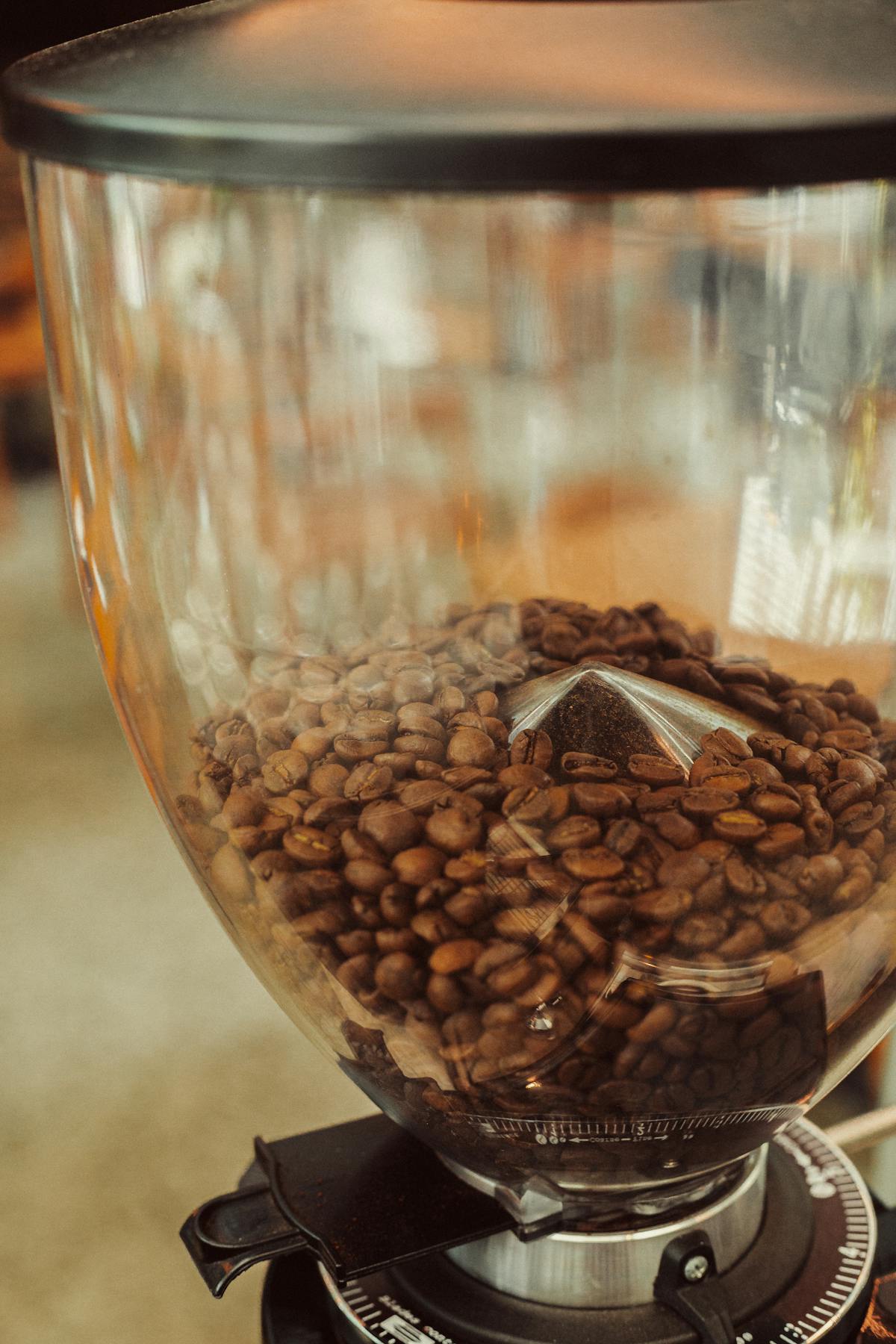
Flat burrs vs conical burrs. The grinder matters as much as the machine. Flat burrs (Eureka, Mahlkönig) cut the bean between two parallel discs. The result: clarity, note separation, precision. You taste every nuance of the bean — the choice for light roasts and espresso without milk.
Conical burrs (Niche, Baratza) crush the bean between an inner cone and an outer ring. The result: body, texture, roundness, chocolate notes. The choice for milk drinks and medium-to-dark roasts.
There is no “better”. It’s a matter of flavour profile, like choosing between a Burgundy and a Bordeaux.
Those who changed hands
Artisan espresso attracts covetous eyes. In a few short years, several historic brands have been acquired. It isn’t necessarily a disaster. Everything depends on what changes at the workbench.
Gaggia, the inventor of crema (Achille Gaggia, spring lever, 1948), has had the most chaotic journey: acquired by Saeco in 1999, swallowed by Philips in 2009 for 242 million dollars, its professional division sold to Evoca in 2017. The brand is split in two. But the Classic E24, recently released, marks a genuine comeback. The controversial aluminium boiler of the 2015 era (523 grams, unstable) has been replaced by a lead-free brass boiler weighing 1,330 grams. The difference is tangible: thermal stability transformed, recovery time between shots halved, steam noticeably more powerful. The group is also brass, and the 3-way solenoid valve is back (it had disappeared on the Romanian-made versions). Manufacturing is once again in Italy. At around 500 euros, it has become once more the entry-level machine that the r/espresso community recommends unanimously.
Baratza, acquired by Breville in 2020 for 60 million dollars, is the example of a successful takeover. The Seattle-based manufacturer has kept its identity and above all its legendary after-sales service: the “Don’t Dump It, Fix It” policy means any part is available individually for 5 to 15 dollars, repair videos cover every operation, and a hotline helps customers diagnose issues themselves. The Encore ESP (the espresso-optimised version of their classic grinder) is probably the most repairable entry-level grinder on the market. In a world of disposable products, that’s an act of defiance.
Lelit, acquired by Breville in 2022 for 113 million euros, continues to manufacture in Brescia. The Bianca V3 is the machine that brought flow control to the home. Its paddle, integrated into the E61 group, regulates in real time the flow from the rotary pump to the brew group. In practice, you can start a shot with a gentle low-pressure pre-infusion, ramp up gradually, then taper off at the end of extraction. The V3 adds a programmable low-flow mode (normal flow is 6.5 ml/s, reducible for the start and end of the shot). PID on both boilers, integrated shot timer. At around 3,000 euros, it’s the benchmark for accessible pressure profiling.
La Marzocco, the Florentine icon of specialty coffee, has come under De’Longhi’s control (over 61% of shares, finalised in 2024 for approximately 374 million dollars). Manufacturing remains in Florence. The Linea Mini remains the ultimate object of desire for the home barista, and the Linea Micra (their most compact machine, inspired by the GS3) features Brew-by-Weight, which automatically stops extraction when the target weight is reached in the cup. Innovation continues. But De’Longhi is a publicly traded group, with shareholders to satisfy. One to watch over time.
Rancilio under Ali Group since 2013: no visible deterioration. Better still: the Silvia Pro X finally brings dual boiler and PID to the Silvia — an upgrade the community had been waiting for for twenty years.
Mahlkönig is grouped under the Swiss holding company Hemro AG alongside Ditting, Anfim, and HeyCafé. The EK43, with its 98mm flat burrs, remains the most revered grinder in specialty coffee. The X54 is its domestic version, at around 700 euros.
Gearing up: the buying guide by budget
Your first serious espresso (400-800 €)
Machine: the Gaggia Classic E24 remains unbeatable for learning. Solid, well-documented, huge community, spare parts available everywhere. It’s a simple machine (single boiler, no PID out of the box), but its new brass boiler gives it a stability that previous versions lacked. Expect around 500 euros.
Grinder: a Eureka Mignon Crono (~200 €) for the clarity of flat burrs, or a Baratza Encore ESP (~200 €) for reliability and repairability. Both do the job honestly at this price. If you can stretch to 300-350 euros, the Eureka Mignon Notte adds noise reduction and a timer — a real quality-of-life upgrade.
The enthusiast setup (1,500-3,000 €)
This is where things get serious. The fundamental choice here is heat exchanger or dual boiler.
HX machine: the Profitec Pro 500 (~1,600 €) or the Lelit Mara X (~1,200 €) are modern heat exchangers with PID. The Mara X has an interesting feature: a “brew priority” mode that automatically optimises brew temperature at the expense of steam power. For those who mainly drink straight espressos, it’s a smart move.
DB machine: the Profitec Pro 700 (~2,500 €) as a dual boiler with analogue pressure gauges and an industrial aesthetic. Or the ECM Classika (~1,500 €) as a single boiler PID for those who never steam milk (yes, they exist, and it’s a beautiful machine).
Grinder: Eureka Mignon Specialità (~500 €) if you prefer a hopper and flat-burr clarity. Niche Zero (~630 €) if you want single-dose and the body of conical burrs. Both are excellent; the choice is a matter of taste.
The no-compromise workshop (3,000-5,000 €+)
Machine: ECM Synchronika II (~3,400 €) for the no-frills German dual boiler. Lelit Bianca V3 (~3,000 €) for flow control and pressure profiling. Rocket R Nine One (~4,000 €) for the saturated group and saveable profiles. Or the La Marzocco Linea Micra (~3,500 €) for Brew-by-Weight and the name that wrote the history of specialty coffee.
Grinder: Mahlkönig X54 (~700 €) for the domestic version of the professional standard. Niche Duo (~750 €) for 83mm flat burrs in single-dose form. Or a Eureka Oro (~600 €) to stay within the Florentine ecosystem.
A golden rule
Invest at least as much in the grinder as in the machine if your budget is tight. An excellent grinder with a decent machine will always produce a better espresso than the reverse. It’s the grind that makes the cup. A Niche Zero at 630 euros with a Gaggia Classic at 500 euros will make a better espresso than a Rocket Appartamento at 1,500 euros with a 100-euro grinder. Always.
What remains
Espresso is 125 years old. It is a craft of families, workshops, and engineers who calibrate boilers to the hundredth of a degree. Bezzera crosses the centuries with the discretion of those who have nothing left to prove. Eureka proves you can be a centenarian and an innovator, by doing only one thing but doing it better than anyone. ECM and Profitec embody a precision that large groups struggle to replicate, because it comes from a family, not a process. Rocket invented the machine-as-object-of-desire and proves you can inspire dreams without sacrificing engineering. Niche changed the way an entire generation grinds its coffee. And Nuova Simonelli proves that independence can also mean global scale, when it is won by those who do the work.
As long as there are families and enthusiasts who refuse to sell, espresso will remain a craft. And the cups will be better for it.