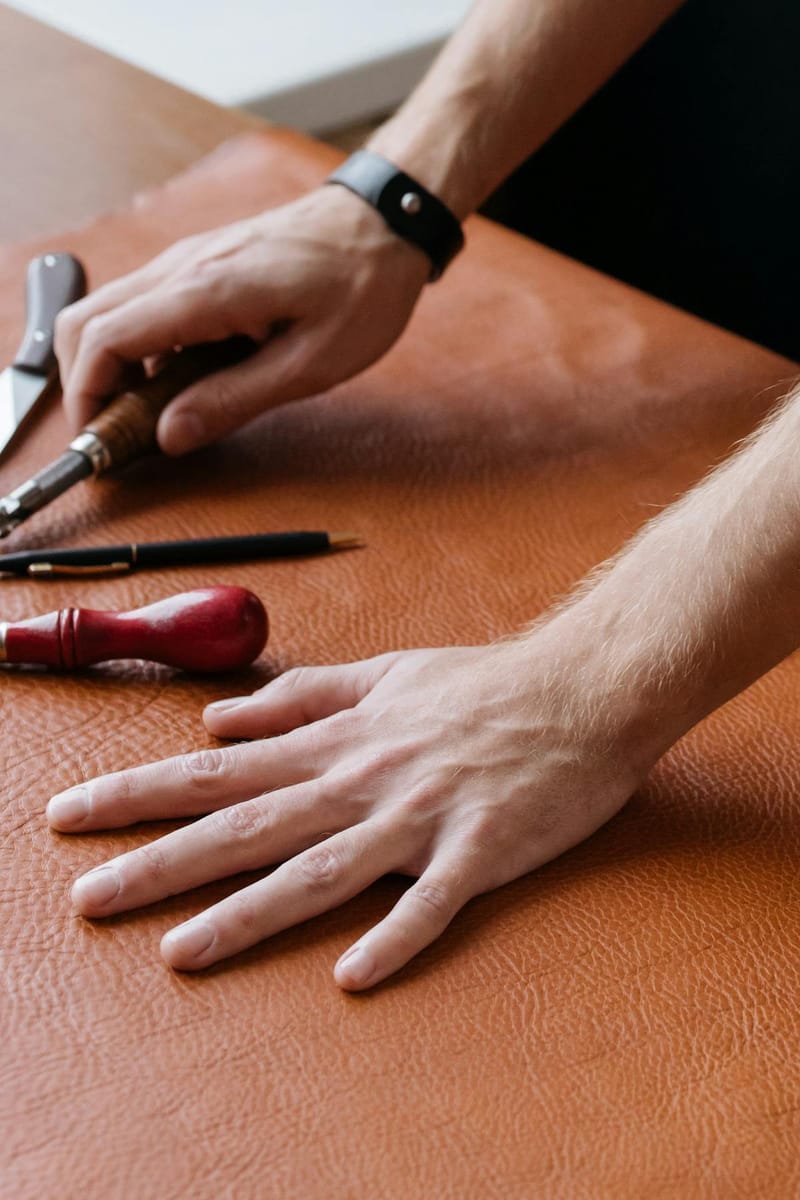
You wear leather every day. Your belt, your shoes, your bag, maybe your jacket. And yet, if I asked you what separates good leather from bad, chances are you’d draw a blank. That’s not a dig. Nobody teaches us this. We’re sold “genuine leather” as though those two words were enough to guarantee anything - when it’s probably the biggest marketing trap in the luxury industry.
The problem is that leather has become a catch-all word. It describes both a full-grain hide tanned for six weeks in a Tuscan workshop and the pulp of offcuts glued with polyurethane that you find in 400-euro sofas. Technically, both are allowed to call themselves “leather.” Legally, it’s more nuanced. But in the consumer’s mind, it’s total confusion.
This article is here to fix that. Not with hollow generalities or tanner jargon, but with concrete information and five simple steps you can put into practice on your very next purchase. The kind of knowledge you normally acquire after years of handling, comparing, and sometimes getting burned.
Because yes, I’ve been burned too. Everyone has been burned at least once.
Understanding leather grades: what nobody ever tells you
Before talking about quality, you need to understand something fundamental: not all leathers are equal, and the difference doesn’t come from the animal. It comes from the layer of skin used and the treatment it undergoes. Picture an animal hide in cross-section: the outer surface, the side that bore the hair, is the densest, most resilient and most interesting part. The deeper you go, the looser the fibers become, and the more the leather loses in quality.
Full grain - the Holy Grail
Full grain is the intact surface of the hide. It hasn’t been sanded, corrected or disguised. It’s leather as nature made it, with its visible pores, slight irregularities and marks of life. It’s also the densest part of the skin, where collagen fibers are packed most tightly.
Why is it the best? Because that natural density makes it incredibly resistant to wear. And above all, it develops a patina over time. That word comes up often and it means something specific: the leather’s surface changes in appearance with use, the oils from your hands, sunlight and friction. A good full-grain leather at ten years old is more beautiful than the same leather brand new. It’s rare, a material that improves with age.
You’ll find full grain at exceptional shoemakers like Corthay or Edward Green, in the leather goods of Peter Nitz or Serge Amoruso, and at the great houses that don’t need to cheat on raw materials.
The downside: full grain is demanding. It shows everything. If the animal had scars, insect bites or barbed-wire marks, they’re visible. That means only a fraction of hides available on the market are beautiful enough to be used as full grain. Hence the price.
Corrected grain (top grain) - the smart compromise
Corrected grain is a full-grain hide that has been lightly sanded on the surface to smooth out imperfections, then coated with a protective film or pigment. The result is a more uniform leather, more resistant to stains and water, but with less character.
It’s an honest compromise when done well. Many high-end automotive seat leathers are corrected grain, and they hold up very well over time. The problem is when it’s sold to you at full-grain prices without disclosure. The difference is in the feel: corrected grain is often smoother, almost plastic in the least refined versions, while full grain has an irregular natural texture under your fingers.
In terms of patina, it’s less interesting. The surface film prevents the leather from “living” as much as a full grain. It will wear decently but won’t develop that characteristic depth of color.
Split leather - the hidden side
When a hide is sliced in half through its thickness to obtain the grain (the top layer), what remains is the split. The fibers there are looser, the material more porous, less resilient. In itself, it’s not waste. Split leather has legitimate uses: shoe insoles, linings, certain types of suede (real suede is actually often a brushed split).
The problem begins when someone takes that split, covers it with a polyurethane film printed to mimic a leather grain, and sells it as “genuine leather.” Technically, it is leather. Practically, it’s misleading. This coated split has neither the strength, nor the patina, nor the lifespan of full grain. It will crack, flake and peel. Have you ever seen an old “leather” sofa peeling like a sunburn? That’s probably coated split.
Bonded leather - the outright scam
This one needs to be called out clearly. Bonded leather is scraps and leather fibers that have been ground up, mixed with polyurethane or latex, and pressed into sheets. It is to leather roughly what surimi is to crab: it technically contains the ingredient, but the result is nothing alike.
Bonded leather typically contains between 10 and 20 percent leather fiber. The rest is plastic and glue. It cracks within months, it doesn’t develop a patina, it has none of the mechanical qualities of leather. And yet, it’s everywhere: book bindings, notebook covers, entry-level furniture, and above all, belts and accessories sold at prices that suggest real leather.
My advice is simple: if you see “bonded leather” on a label, walk away. It’s not leather. It’s a composite that uses the word leather to justify a price.
Tanning: how a hide becomes leather
A raw hide rots. To transform it into leather - a stable, supple and durable material - you have to tan it. And the type of tanning radically changes the final result. It’s a subject most consumers know nothing about, even though it may be the single most important factor in leather quality.
Vegetable tanning - the art of patience
Vegetable tanning is the oldest method. Natural tannins extracted from tree bark - oak, chestnut, mimosa, quebracho - are used to stabilize the skin’s fibers. The process takes a minimum of two to six weeks, sometimes several months for the thickest hides. The skins are immersed in baths of increasing concentration, slow and delicate work that cannot be rushed.
The result is a leather with a firm feel, almost rigid at first, that softens beautifully with use. The colors are warm, in shades of honey, cognac and natural brown. And above all, it’s the tanning method that produces the finest patina. A vegetable-tanned leather at five years old is a living object that tells its own story.
Bleu de Chauffe uses almost exclusively vegetable-tanned leather for its bags and accessories - it’s actually one of their founding principles. Tuscan tanneries like Badalassi Carlo (known for their Pueblo and Minerva Box leathers) and Walpier have made it their specialty. In Japan, Tochigi Leather carries on this tradition with characteristically Japanese rigor.
The honest limitations: vegetable leather is sensitive to water (it stains easily), it’s more vulnerable to UV (it darkens in sunlight), and its initial stiffness can be off-putting. It accounts for about 10% of global production because it’s slow and costly to produce.
Chrome tanning - the global standard
Chrome tanning uses trivalent chromium salts (Cr III) to fix the fibers. The process takes just one day, sometimes less. This industrial efficiency is what made it the dominant method: roughly 85% of the world’s leather is chrome-tanned.
Chrome-tanned leather is supple from the start, water-resistant and available in a virtually infinite palette of colors (vegetable tannins limit the chromatic range; chrome does not). It’s an excellent leather when done well. The majority of luxury shoes you know use chrome-tanned leather.
The environmental and health question deserves an honest answer. Trivalent chromium (Cr III) used in tanning is not toxic in itself. The problem is hexavalent chromium (Cr VI), a recognized carcinogen that can form under poorly controlled manufacturing conditions. In modern, well-managed tanneries, it’s a non-issue: European standards are strict and inspections regular. However, in certain tanneries in Bangladesh or India where regulations are less enforced, it’s a real risk - both for the workers and the end consumer.
Combination tanning - the best of both worlds
Some leathers combine both methods to stack the advantages. The most famous is undoubtedly Horween’s Chromexcel, from the legendary Chicago tannery founded in 1905. Chromexcel undergoes a double tanning - chrome then vegetable - followed by intensive feeding with oils, fats and waxes. In total, 89 steps over 28 days. The result is a leather as supple as chrome-tanned, that develops a patina like vegetable-tanned, with a characteristic pull-up effect: when you bend it, the oils migrate and create lighter areas. It’s the most famous leather among enthusiasts of welted shoes.
Paraboot uses Horween Chromexcel on some of its models, and the result is spectacular. The Barenia produced by Tanneries Haas for Hermès is another legendary example of combination tanning - vegetable and chrome combined to achieve a leather that develops an exceptional patina over time.
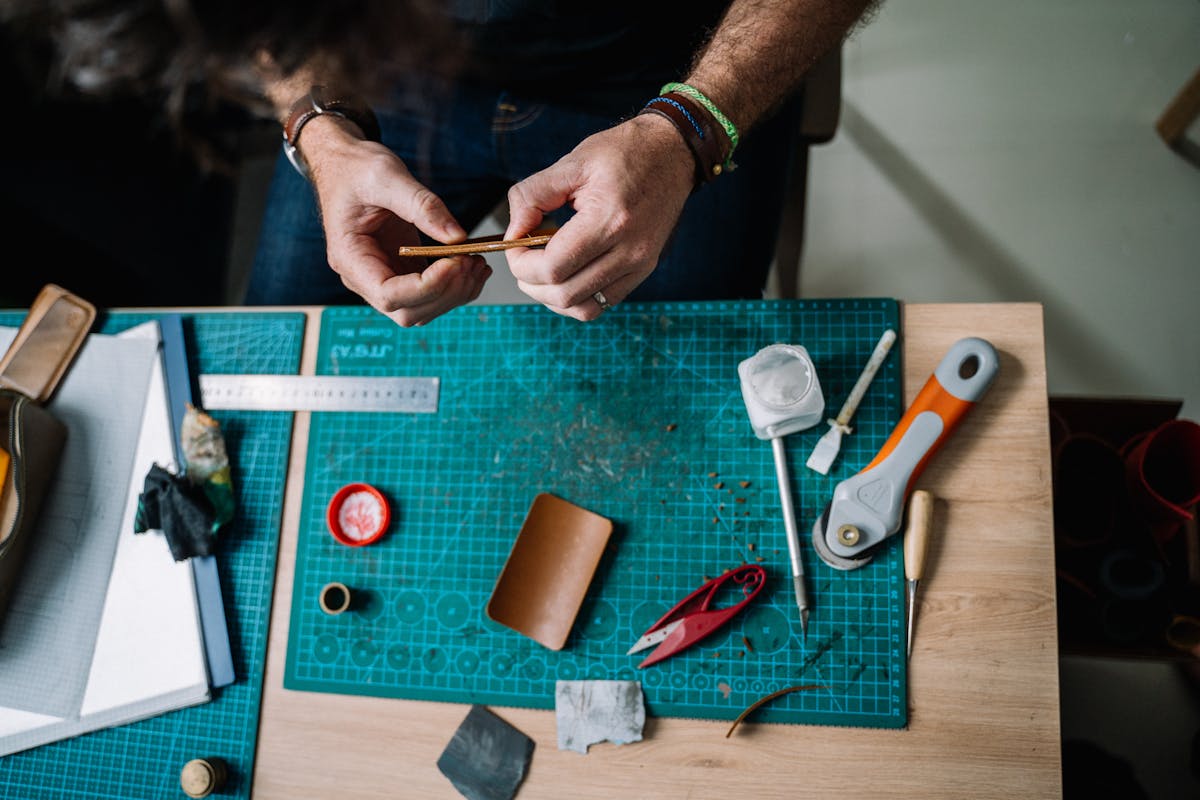
5 steps to recognize quality leather
Let’s get practical. Here are five simple steps you can use in a shop, at a flea market, or in front of a website (for the last one). No single step is foolproof on its own, but combined, they’ll give you a reliable reading of what you’re holding.
Step 1: Look at the edge
This is the most revealing and most overlooked step. The edge of a piece of leather is its cross-section - the visible border where the leather isn’t folded over on itself. On a belt, it’s the side. On a bag, check the inside of pockets or unlined areas.
Quality full-grain leather has a clean edge, uniform in color, with tight, visible fibers. If the maker is serious, the edge is dyed, polished, sometimes burnished with linen thread for a flawless finish. It’s handcraft work that takes time.
Poor-quality leather shows a fibrous, fuzzy edge with visible layers pulling apart. If you see a distinct plastic film glued onto a loose, fibrous base, that’s coated split. Run.
At the best ateliers - Corthay for shoes, Peter Nitz for leather goods - edge finishing is an obsessive quality marker. Multiple layers of dye, meticulous polishing, sometimes decorative fileting. It’s a detail that never lies.
Step 2: Smell it
Leather has a smell. A real smell, organic, complex, that your nose recognizes instinctively even if you can’t describe it. It’s a blend of earthy, animal notes, sometimes slightly sweet (especially for vegetable tanning) or more mineral (for chrome).
Fake leather smells like plastic. PVC and polyurethane have a chemical, synthetic odor that nothing can fully mask. Some manufacturers add artificial leather fragrance - yes, that exists - but a slightly trained nose spots them quickly: it’s too perfect, too uniform, lacking the complexity of the real thing.
Bonded leather often has an unpleasant mixed smell: an undertone of industrial glue with vaguely animal notes. It’s the scent of chemical compromise.
A good test: if an object supposedly made of leather smells like nothing at all, be suspicious. Real leather always has a scent, even a faint one.
Step 3: Touch and fold
Pick up the object and gently fold it over on itself. Good full-grain leather will form fine, natural, irregular creases - like the wrinkles on human skin. Those creases disappear when you let go. The leather springs back. It has memory, a natural elasticity tied to the structure of its collagen fibers.
Poor-quality leather or faux leather will either hold the fold (no elastic return) or show cracks at the crease. The surface film splits, the fibers separate. It’s irreversible and a sign the material won’t last.
Touch tells a story too. Real leather has a temperature: it’s cool on first contact but warms quickly with the heat of your hands. Plastic stays cold or turns clammy. Full-grain leather has an irregular grain under your fingers, a living texture. Faux leather is too uniform, too smooth, almost sticky.
The pull-up test is a bonus for oiled leathers like Chromexcel or Barenia: press your thumb down and slide it. If the color lightens under pressure then returns, it’s a leather deeply nourished with oils and waxes. That’s the sign of a quality tanning process.
Step 4: Look for imperfections
It’s counterintuitive, but leather that’s too perfect is suspicious. Uncorrected full grain, by definition, retains the natural marks of the animal’s skin: slight variations in grain, vein traces, sometimes tiny scars or differences in density between the shoulder and belly areas.
These imperfections are proof of authenticity. A full-grain hide from a European calf raised on pasture will carry different marks from one raised in industrial farming. Artisans know this and select their hides accordingly: a mark on a discreet area isn’t a defect, it’s the signature of a natural material.
Conversely, a leather whose surface is perfectly uniform, without the slightest variation in grain or color, has probably been corrected (sanded and coated). That’s not necessarily bad - corrected grain has its qualities - but it’s not worth the price of full grain.
Great houses like Berluti have turned this natural imperfection into an art form: their Venezia patina, applied by hand, plays with the leather’s natural variations to create unique depth effects. Every pair is different, and that’s precisely the point.
Step 5: Read the label intelligently
The last step doesn’t involve your hands but your eyes. And a healthy dose of skepticism.
“Genuine leather” / “Cuir véritable”: these labels guarantee nothing more than the presence of leather somewhere in the product. In English, “genuine leather” is often presented as the marker for the lowest grade of real leather. The reality is more nuanced: some reputable tanners, including Horween themselves, use this label for quality leathers. On specialized forums like r/goodyearwelt, this “grade hierarchy” is regularly debunked as a marketing myth. What is true, however, is that manufacturers working with full grain say so. If the label stops at “genuine leather” without further detail, it’s rarely a good sign.
“100% leather”: slightly better, but still vague. 100% leather of what type? Full grain? Split? Bonded? The label alone isn’t enough.
“Full grain leather”: now that’s a precise commitment. The manufacturer is stating they use the uncorrected top layer of the hide. That’s what you’re looking for.
“Calfskin”: indicates the animal source, not the grade. A calf produces a finer, more supple leather than an adult bovine, but it can be full grain or split.
“Vegetable leather”: beware the trap. In the context of tanning, “vegetable leather” means tanned with natural tannins - that’s an excellent thing. But some fashion brands use “vegetable leather” or “vegan leather” to describe faux leather made from polyurethane or plant-based materials. That’s not leather at all. Read the fine print.
Transparency is a quality signal in itself. Serious brands name their tanneries, specify the type of tanning, sometimes even the origin of the hides. Bleu de Chauffe speaks openly about its vegetable-tanned leathers. Guibert Paris details its sources. When a brand is vague about its raw material, it usually has something to hide.
The great tanneries: the names you should know
Leather isn’t just about the brand that stitches the final product. First and foremost, it’s about the tannery that transforms a raw hide into a noble material. The great tanneries are to leather goods makers what great vineyards are to wine merchants: the source of everything. Here are the names that matter.
France - a heritage being acquired
France has an extraordinary tanning tradition, but let’s be clear-eyed: the major luxury groups have methodically bought up the country’s best tanneries to secure their supply.
Tanneries Haas (1842, Alsace) - The most prestigious name. Producers of Barenia, Hermès’s signature leather: a vegetable-chrome combination tanning that yields a leather with a legendary patina. Haas supplies the greatest houses in the world. Acquired by Chanel in 2018.
Tannerie d’Annonay - Annonay has been a leather town since the Middle Ages. The Tannerie d’Annonay, heir to the Combes and Meyzonnier houses, now belongs to Hermès. It produces some of the world’s finest high-end calfskin, the kind found at the great French shoemakers.
Tanneries Du Puy (acquired by Hermès in 2015), Tanneries Roux in Romans-sur-Isère (integrated by LVMH) and Degermann round out this landscape of French excellence. Only a handful of high-end tanneries remain in France, and nearly all now belong to luxury groups - Hermès, Chanel, LVMH.
This vertical integration movement says something important: the major groups know that leather quality is the limiting factor of their production. Without access to the best hides and the best tanners, even the finest artisan can’t create anything exceptional.
United States - Horween, the Chicago legend
Horween Leather Company (1905, Chicago) is probably the most famous tannery in the world among leather enthusiasts. Two products have made it legendary.
Chromexcel, which I described earlier, with its 89 steps over 28 days. It’s a leather that has spawned something close to a cult among welted shoe enthusiasts. Supple, pull-up, rich in oils, it ages spectacularly. Paraboot uses it on some of its most sought-after models.
Shell Cordovan is even more fascinating. It’s not leather in the traditional sense: it’s a dense, fibrous membrane located inside the hide of the horse’s rump, between two layers of epidermis. A layer of tightly packed fibers with no visible grain. The result is an extraordinarily smooth leather with a deep natural sheen that requires no polish. It doesn’t crease like conventional leather - it rolls, it ripples. And it’s extremely durable. The catch: its rarity. Each horse yields only two small pieces of cordovan, and the tanning takes a minimum of six months. Hence prices reaching 120 to 130 dollars per square foot in 2026.
Japan - absolute rigor
Shinki Hikaku is the other great name in Shell Cordovan worldwide. This Himeji tannery produces a cordovan often judged even finer than Horween’s: tighter, shinier, with exclusively vegetable tanning (where Horween uses a combination). The finest pairs of Japanese cordovan shoes reach the pinnacle of refinement.
Tochigi Leather, based in the prefecture of the same name, is Japan’s benchmark for vegetable-tanned bovine leather. Their process uses traditional pit tanning and produces a dense, firm leather that develops an exceptional patina. Their leathers appear in products from many Japanese artisans and brands, including certain leather lines from Porter-Yoshida.
Italy - Tuscany in its glory
Italy, and Tuscany in particular, is the cradle of artisanal vegetable tanning. The Vera Pelle Italiana Conciata al Vegetale consortium brings together the tanneries that carry on this tradition.
Badalassi Carlo has gained worldwide renown thanks to two leathers that have become cult favorites: Pueblo, a raw leather with an almost powdery look that develops a spectacular patina, and Minerva Box, a supple full-grain leather rich in waxes. Leather artisans around the world compete for them.
Conceria Walpier produces vegetable-tanned leathers of remarkable fineness, used by many high-end leather goods houses. Their Buttero is a classic of the genre.
United Kingdom - bridle leather and heritage
J&E Sedgwick (Walsall) is the global reference for bridle leather - that thick, deeply waxed hide originally designed for equestrian equipment. It’s a vegetable-tanned leather, fed with tallow and beeswax for weeks, with an almost architectural rigidity that slowly softens with use. Swaine Adeney Brigg, the British house specializing in travel and equestrian goods, has been using this type of leather for over two centuries.
Thomas Ware & Sons (Bristol), founded in 1840, claims the title of the oldest tannery still in operation in the United Kingdom. Specializing in heavy leathers for soles and equipment, it’s a living remnant of the golden age of English leather.
Brands in the guide that work with the finest leathers
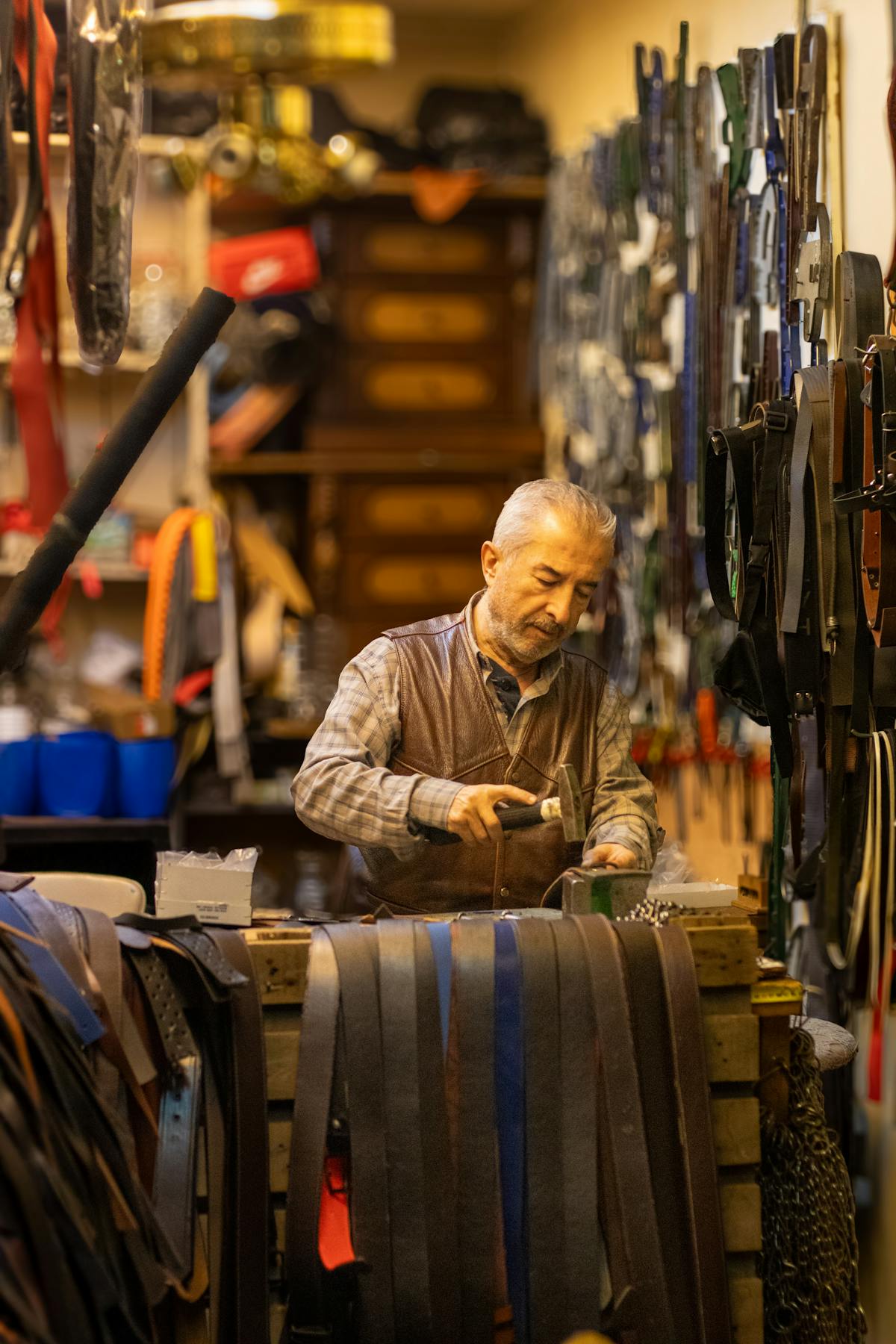
Knowing leathers and tanneries is one thing. Knowing who puts them to work with talent is another. Here’s a selection of brands featured in the sulkowski.fr guide that stand out for the quality of their leathers - not for their marketing, not for their prices, but for their choice of raw materials and their craftsmanship.
Shoes - where leather matters most
A shoe is leather’s ultimate test. It endures repeated flexing, moisture, impact and ground abrasion. Bad leather gives itself away within months on a shoe.
Corthay works with the finest Annonay calfskins and offers hand-patinated finishes that rival painting. Each pair is unique, and the leather is treated like an artist’s canvas. Pierre Corthay has elevated the French shoe to the status of a work of art.
Edward Green (Northampton, since 1890) is a monument of English shoemaking. Their calfskins and cordovans are selected with obsessive standards. The Galway in Utah grain or the Dover in cordovan are absolute benchmarks for anyone seeking leather that ages with nobility.
Gaziano & Girling, a younger Northampton house, quickly reached the summit thanks to hand-picked leathers and construction of surgical precision. Their use of hatch grain and museum calf (leathers patinated at the tannery) is remarkable.
J.M. Weston embodies the classic French shoe. Their Limoges manufacture works with French leathers, and their famous 180 loafer has become a heritage object. Weston’s box calf leather is a standard of robust elegance.
Paraboot may surprise on this list, and that’s exactly what makes it interesting. A more accessible brand than the others, Paraboot offers certain versions of the Chambord and Michael in Horween Chromexcel (editions coveted by enthusiasts), works with Haas leathers (Suportlo, Novonappa) on its classic models, and Norwegian-welted calfskin of formidable durability. The quality-to-material-to-price ratio is unbeatable.
Berluti holds a place apart thanks to its Venezia patina, a technique for coloring full-grain leather using alternating layers of water and pigmented waxes, applied with a cotton cloth wrapped around the fingers, layer after layer. The result is a leather with deep, almost translucent reflections whose color evolves over time. Alessandro Berluti and then Olga Berluti elevated this technique to the level of art. The Venezia is tanned specifically to absorb these patinas - it’s a full-grain calfskin of exceptional receptivity.
Leather goods - everyday excellence
A well-made bag or wallet in good leather is a companion for decades.
Peter Nitz is a Zurich-based artisan who works alone and produces some of the most beautiful leather goods in the world. His leathers come from the finest French and Italian tanneries, and his edge finishing is a subject of study for other artisans. A Peter Nitz piece is an investment that never loses value.
Oberwerth makes camera bags in full-grain leather of exceptional quality. For photographers seeking a bag that protects their gear while aging beautifully, it’s the German benchmark.
Bleu de Chauffe is a French brand that has made vegetable-tanned leather its identity. Based in Limoges, it works with French and Italian tanneries to produce bags and accessories in raw leather that develop a patina over time. Their commitment to material traceability is exemplary in this price range.
Guibert Paris comes from the equestrian world, and that heritage shows in the choice of leathers: robust, dense, built to last. Their saddlery-leather bags and belts are made to endure the years.
Serge Amoruso is a Parisian artisan whose hand-stitched full-grain leather goods reach a rare level of refinement. Each piece is an exercise in precision and respect for the material.
Swaine Adeney Brigg carries on the tradition of English bridle leather in London. Their attaché cases and travel bags in Sedgwick bridle leather are monuments of solidity. A Swaine bag is made to be passed down, not replaced.
Leather in other forms
Porter-Yoshida, the Japanese house founded by Kichizo Yoshida in 1935, is best known for its bags in technical nylon. But their leather lines, made with Tochigi and other Japanese tannery leathers, are of remarkable quality. Japanese rigor applied to vegetable-tanned leather produces objects of exceptional precision and patina.
Inden-Ya is a case unique in the world. This house from Yamanashi, Japan, has been working with urushi-lacquered deer leather for over 400 years. Urushi, a natural lacquer drawn from the lacquer tree, is applied to deer leather using a technique passed down through generations. The result is a material that is supple, lightweight and surprisingly resilient, with traditional patterns of striking beauty. Nothing comparable exists anywhere else in the world.
Eastman Leather Clothing reproduces American military flight jackets from the 1930s through the 1950s using leathers tanned to the original specifications. Their horsehide and goatskin are sourced from specialized tanneries, and the result is staggering: these are probably the finest flight jacket reproductions in the world. The horsehide they use is vegetable-tanned, thick and develops a patina that gives each jacket a unique character after a few years of wear.
Care: keeping your leather alive
The finest leather in the world, if you neglect it, will eventually dry out, crack and die. Leather care is neither complicated nor time-consuming, but it is essential. A few simple rules are all you need.
The essential trio
Conditioning cream is the fundamental step. It rehydrates the leather’s fibers and maintains its suppleness. Frequency: every one to two months for regularly worn shoes, every three to four months for a bag. Saphir creams (the Médaille d’Or range in particular) have been the market benchmark for decades. Apply a thin layer with a soft cloth or brush, let dry, buff.
Polish adds color and shine. Unlike cream, it forms a protective film on the surface. You don’t polish a bag (except bridle leather), but you polish your shoes. Beeswax, turpentine, pigments: a good polish contains few ingredients. Saphir and Famaco are reliable choices.
Balm or grease is reserved for thick, oiled or heavily exposed leathers: hiking boots, leather jackets, travel bags. It nourishes deeply and partially waterproofs. Be careful not to overdo it: too much grease suffocates the leather and darkens the color irreversibly.
Techniques to know
- Always dust before conditioning. A damp cloth will do, or a soft-bristle brush.
- Never dry wet leather near a heat source. Radiator, hair dryer: forbidden. Leather dries in open air, at room temperature, stuffed with newspaper to absorb moisture from within.
- Use cedar shoe trees for your shoes. Always. It’s the most cost-effective investment in your wardrobe. Cedar absorbs moisture and maintains the shape.
- Rotate your pairs. Leather needs 24 to 48 hours to fully dry between wearings. Wearing the same pair every day is a death sentence.
- Waterproof light-colored and vegetable-tanned leathers before first use. A fluorocarbon-based spray will do the job without altering the appearance.
Monsieur Chaussure is an essential Paris address for leather care. Their expertise ranges from simple polishing to the full restoration of damaged shoes. And their online advice is a goldmine for learning the right techniques. If you’re in Paris and don’t know where to start, walk through their door.
Final thoughts
Leather is a living material. It’s a former skin, transformed by millennia of craft into something beautiful and lasting. When it’s well chosen and well maintained, it ages with you. It adapts to your body, your movements, your life. It tells a story - yours.
Bad leather tells no story. It cracks, it peels, it ends up in the trash after a few seasons. And with it, the resources, the energy and the money it took to produce.
The math is simple: a vegetable-tanned full-grain leather wallet at 150 euros that lasts 15 years costs 10 euros a year. A coated split wallet at 30 euros that cracks after 18 months costs 20 euros a year - and it ends up in a landfill. Buying less but better isn’t just another eco-friendly slogan. It’s arithmetic.
The five steps described in this article won’t make you a leather expert overnight. But they’ll give you the tools to ask the right questions, see through the marketing traps, and recognize quality when you’re holding it in your hands. The rest will come with time and practice - exactly like the patina on a fine piece of leather.