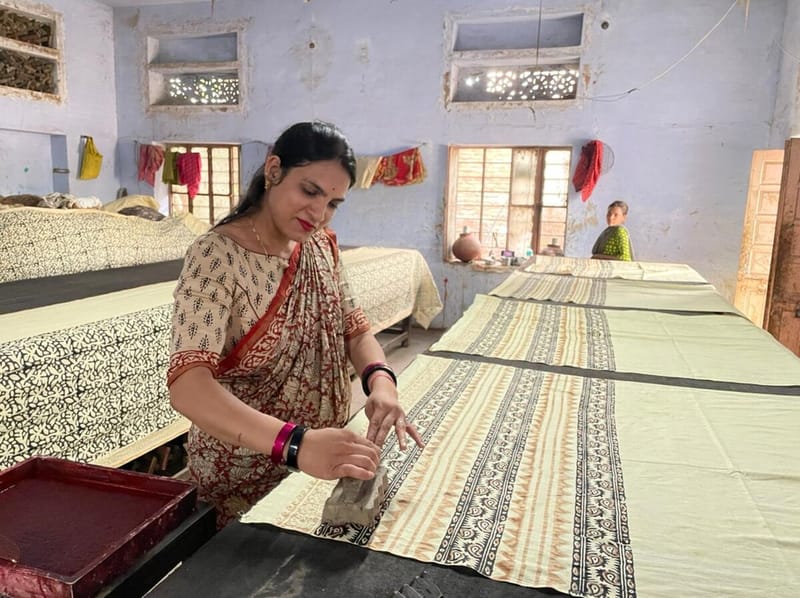
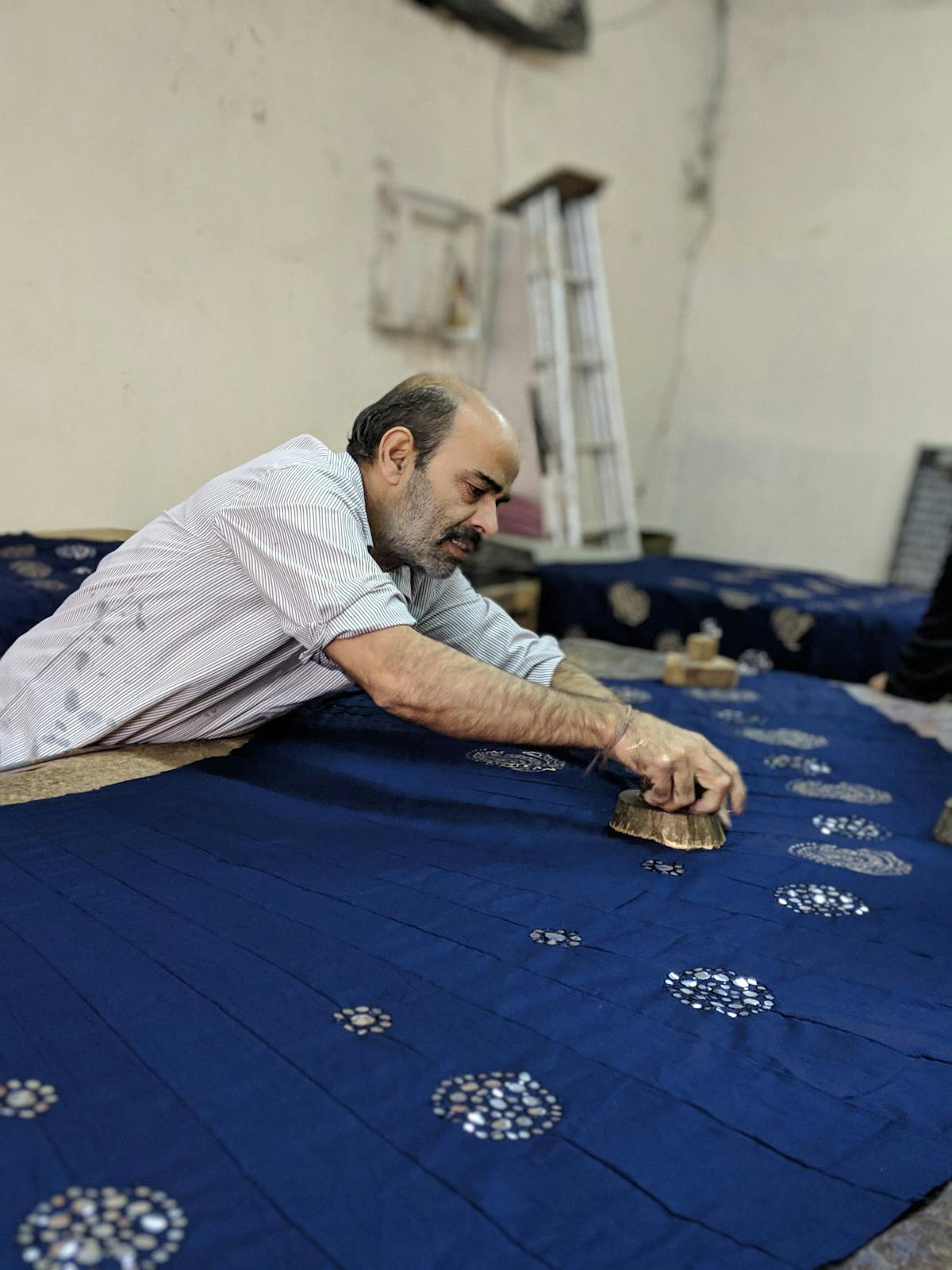
In Bagru, thirty kilometres from Jaipur, a man dips a hand-carved teak block into a vat of indigo dye. He places it on cotton fabric stretched across the ground, strikes twice with the flat of his palm, lifts the block, repositions it one centimetre further, and starts again. He will repeat this gesture eight thousand times today. His father did the same. His grandfather too. The digital printer installed in the Sitapura industrial park, on the other side of Jaipur, produces the same pattern in four minutes.
Two Worlds, One City
Jaipur is the world capital of block-print. Not as a metaphor - by volume. Rajasthan accounts for the majority of India’s block-printed textile output, and Jaipur is the epicentre. Two peripheral villages share most of the expertise: Bagru, to the south-west, and Sanganer, to the south.
Bagru is the village of the Chhipa, the printer caste that has practised this craft since the 17th century. The name comes from the Hindi chhapna - to print. The Chhipa work with natural dyes: indigo, madder, pomegranate, myrobalan. The patterns are geometric, earthy, raw. Fabrics leave the workshop smelling of earth and iron.
Sanganer produces a finer, more colourful block-print, often on a white base. Floral patterns dominate. The work is more delicate, the blocks smaller, the colours brighter. Sanganer historically supplied the princely courts of Rajasthan, then the export markets. Today, most orders for Western brands ship from there.
Forty minutes down the road, the digital printing factories of Sitapura and Mansarovar process the same fibres with piezoelectric print heads that spray microdroplets of reactive ink. No block, no vat, no sun-drying. An Illustrator file, a machine, a roll of fabric. Rajasthan produces both. The coexistence is less peaceful than it looks.
The Block: What the Hand Does
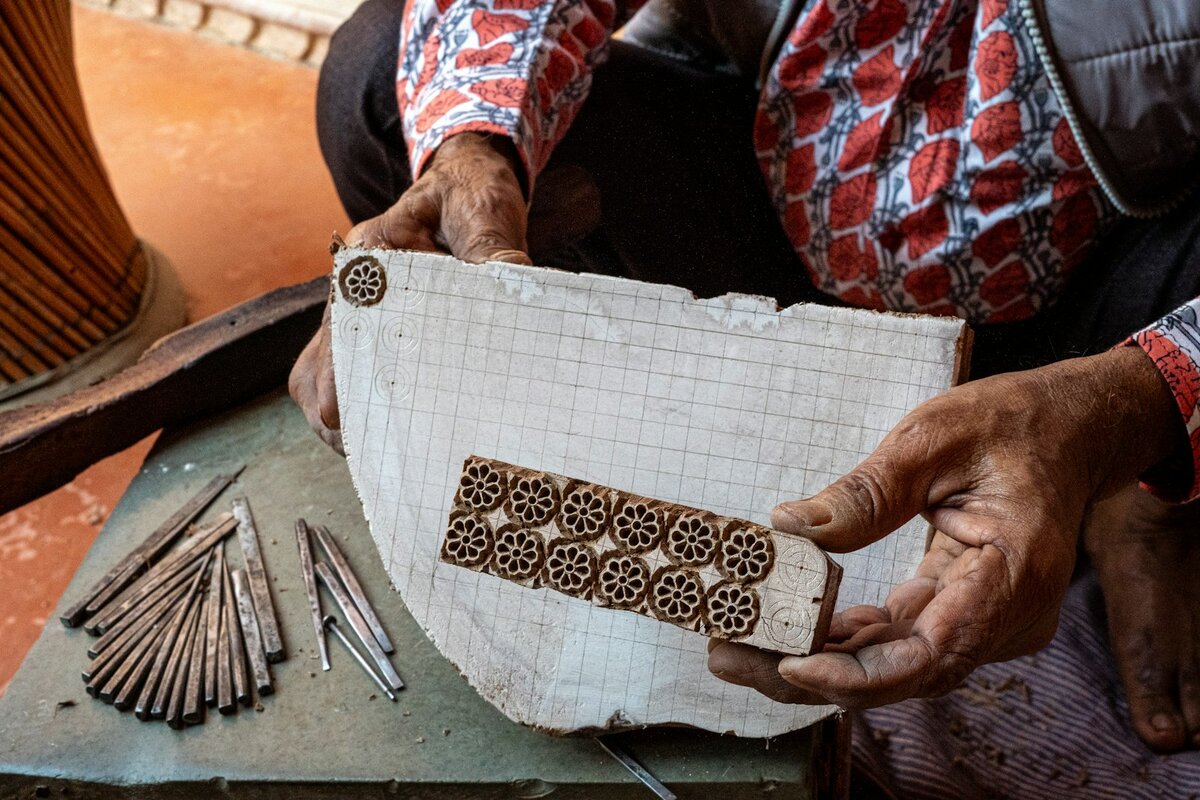
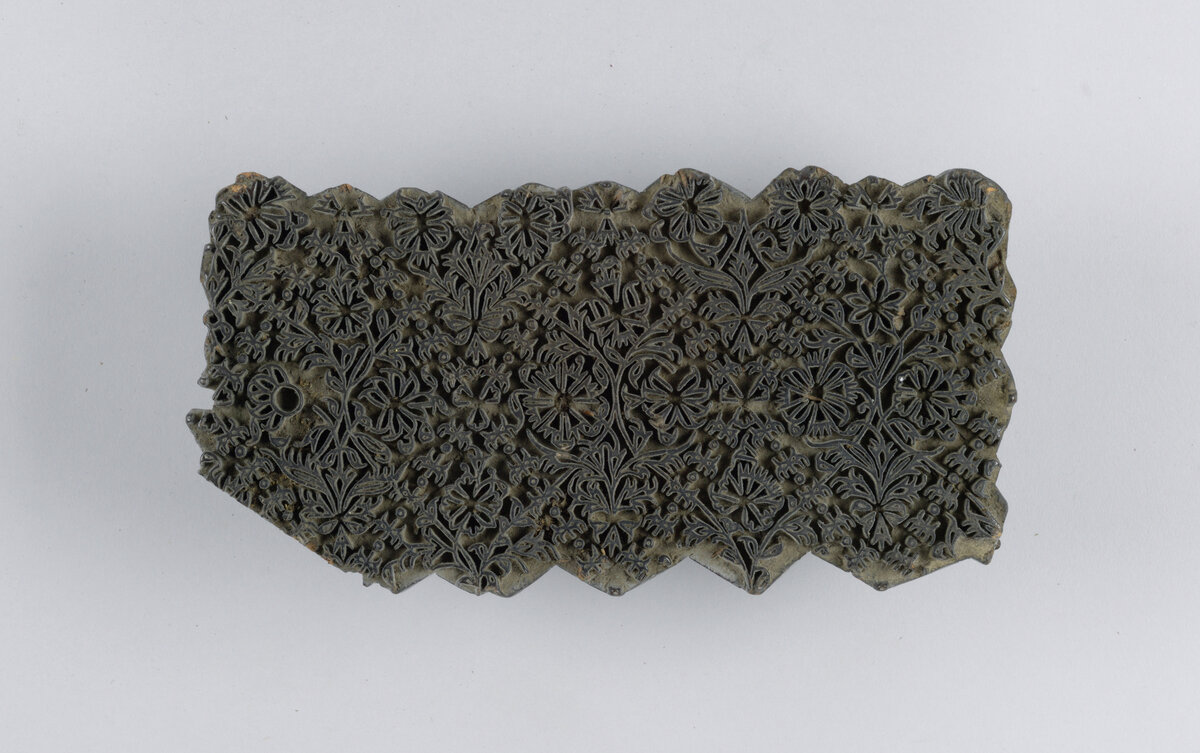
A block-print block is a piece of teak - sometimes sheesham - carved by hand by a kharati, a specialist engraver. Carving a complex block takes between three and seven days. A sari pattern can require fifteen to twenty different blocks: one per colour, one per section of the design. A complete set of blocks for an elaborate pattern represents weeks of work before the first print even begins.
The printer works on the ground, crouching or sitting cross-legged. The fabric is stretched on a padded table. The dye vat is within arm’s reach. The gesture is precise but not mechanical: each placement of the block adjusts to the millimetre, guided by visual cues - small pins carved into the sides of the block that indicate alignment. The printer constantly corrects pressure, angle, ink quantity. No two palm strikes are ever identical. This controlled irregularity is what gives block-print its texture.
After printing, the fabric is washed, sometimes several times. Bagru’s natural dyes require a fixing process using dabu - a paste of mud, lime and gum that acts as a resist. The fabric is soaked, dried in the sun, soaked again. The full process, from first print to finished fabric, takes between four and fifteen days depending on design complexity and number of colours.
An experienced printer produces between eight and twelve metres of fabric per day for a simple pattern. For a complex five- or six-colour pattern, it drops to three to five metres. Some ceremonial fabrics with very fine patterns fall below one metre a day.
The Machine: What Speed Does
An industrial-grade digital textile printer - Mimaki, Durst, MS Printing - covers between 200 and 400 square metres per hour in production mode. In an eight-hour day, that is 1,600 to 3,200 square metres. What a workshop of ten printers produces in a month, the machine does in a day.
The process is straightforward. A designer creates the pattern on a computer. The file goes to the RIP (Raster Image Processor). The machine prints directly onto pre-treated fabric. Reactive or pigment inks are fixed by steam or heat. The fabric comes out ready for cutting.
No block to carve. No sun-drying. No river washing. No variation from one metre to the next. Every square centimetre is identical to the one before it. That is the principle, and also the limitation.
The Sitapura factories run for major international retailers that need volume and short lead times. An order for 10,000 metres of a “block-print inspired” pattern ships in a few days. The same volume done by hand would take months and require dozens of artisans.
The Comparison: Cost
This is where the numbers do the talking.
Block printing, Bagru/Sanganer: Production cost per metre of block-printed fabric ranges from 150 to 600 rupees (€1.70 to €7) depending on pattern complexity, number of colours and dye type. A natural-dye fabric with five block passes and dabu fixing easily exceeds 500 rupees per metre. Labour accounts for 60 to 70% of the cost. Natural dyes, when genuinely natural, add a 30 to 50% surcharge over chemical dyes.
Digital printing, Sitapura: Production cost sits between 80 and 200 rupees per metre (€0.90 to €2.30). Ink is the main expense, followed by machine amortisation. Labour is marginal - one operator for a machine that does the work of thirty artisans.
Ratio: Artisanal block-print costs two to five times more than digital printing. For complex pieces with natural dyes, the ratio can reach eight.
But those figures do not tell the whole story. The startup cost is inverted. To print a new pattern digitally, you just need a file - virtually zero cost. For a new block-print pattern, you need to carve the block set: 2,000 to 15,000 rupees per block, multiplied by the number of blocks needed. A six-colour design can require an investment of 50,000 rupees (€570) before the first print. That is a barrier for small orders, an advantage for large runs where the block cost amortises.
The Comparison: Quality
Quality cannot be measured on a single scale. It depends on what you are looking for.
Pattern precision. Digital printing wins, and by a wide margin. 600 to 1,200 dpi resolution, faithful gradient reproduction, perfect repeat. Block-print works at a resolution determined by the human eye - variable, organic, imperfect. The joints between two block placements are visible if you know where to look. For a designer who needs an exact Pantone match, digital is the only option.
Texture. Block-print wins. The pressure of the block pushes dye into the fibres in a way that sprayed microdroplets cannot replicate. Block-printed fabric has a relief, a grain. The dye penetrates unevenly, creating density variations that give the pattern a depth digital printing cannot reach. This is what informed buyers call hath ka kaam - the work of the hand. You feel it before you see it.
Colour range. Digital advantage. A textile printer reproduces millions of colours. Bagru’s natural dyes offer a limited palette - indigo, madder red, pomegranate yellow, iron black, kattha brown. Rich, deep, but restricted. Workshops using chemical dyes broaden the palette, but lose the ecological argument and the distinctive depth of natural pigments.
Rendering on heavy fabric. Block advantage. On a thick cotton like khadi or kora, the block prints better than the machine. The weight of the strike forces the dye to penetrate dense fibres. Digital ink, projected onto the surface, penetrates less and can look superficial on heavy fabrics.
The Comparison: Durability
This is where natural-dye block-print distinguishes itself most clearly.
Wash resistance. Natural dyes fixed with dabu and alum hold up remarkably well. They do not fade - they evolve. A Bagru fabric dyed with natural indigo softens with each wash, the shades develop a patina, the blue gains a depth the new fabric never had. Bagru printers say their fabrics are “finished by time.” Reactive digital inks hold up well in the wash - that is their selling point - but they do not change. They hold, then they fade. Ageing is not patina, it is degradation.
Light resistance. Variable in both cases. Natural indigo resists UV well. Madder reds somewhat less. Reactive digital inks score reasonably on lightfastness (5 to 6 on the 8-point scale), but over the long term - ten, twenty, fifty years - natural mineral and plant dyes have a track record that synthetic inks do not. Rajasthan’s textile museums display block-prints two hundred years old with colours still legible. Commercial digital textile printing is barely thirty years old. Nobody knows what it looks like at fifty.
Fabric lifespan. Cotton printed by block and treated with natural dyes is not weakened by the process. Traditional mordants - alum, iron, tin - sometimes reinforce the fibre. Digital inks do not damage the fabric, but the chemical pre-treatment needed for fixation (padding with alkaline agents) can stiffen the cotton and accelerate wear.
Why Fashion Houses Are Coming Back
In January 2026, the Jaipur Literature Festival (15-19 January) once again drew international attention to the city and its craft heritage. National Geographic had published a guide to Jaipur’s visitable workshops as early as 2023, a sign of growing interest. The city has repositioned itself as a hub for a high-end textile sector that uses authenticity as a differentiator.
The keyword is traceability. In a market where supply chain transparency is becoming a regulatory obligation (the European ESPR regulation requires a digital passport for textiles, with delegated acts expected by 2027), artisanal block-print offers something digital printing cannot: a direct link between the product and the hand that made it. A fabric printed by block in a Bagru workshop has a name, a face, a place. A digitally printed fabric has a batch number.
Houses like Anokhi (founded in 1970 by John and Faith Singh, now a global block-print reference) have built their model on this traceability. Others are following. European sustainable fashion brands order small runs block-printed in Sanganer, for capsule collections where the artisanal argument justifies a retail price well above industrially printed fabric.
The calculation is not philanthropic. Artisanal block-print costs more to produce, but it sells for much more. Volume is lower, unit margin is better.
What the Block Cannot Do
Block-print is not a universal solution. It cannot fulfil a 50,000-metre order in two weeks. It cannot reproduce a photographic pattern. It cannot guarantee an exact Pantone match from one batch to the next. It cannot adapt to a design change without carving a new set of blocks.
For fast fashion, block-print is an economic nonsense. Zara, H&M, Primark - these brands need volume, speed and low prices. Digital printing was made for them. Block-print belongs to another world: small volume, long time, deliberate imperfection.
The danger lies in the grey zone. Brands that buy machine-printed fabric with a “block-print inspired” pattern and sell it as artisanal. Fake dabu, computer-generated motifs that mimic the irregularity of hand placement. It exists, it sells, and it blurs the line between original and copy.
And this is precisely where the consumer is left on their own. No label reliably distinguishes a fabric printed in Bagru over eight days from one printed in Sitapura in four minutes with an “artisanal” filter. Labels do exist - GI tags, fair trade certifications, initiatives like the Craftmark from the All India Artisans and Craftworkers Welfare Association - but their coverage is patchy and their readability near zero for a European buyer facing a market stall or a website. The only reliable filter remains knowledge: knowing what you are looking at, understanding what the price means, identifying the signs of genuine block-print (irregular joints, dye penetration visible on the reverse, residual mordant smell on recent pieces). That is the kind of sorting this guide tries to make possible.
What the Machine Cannot Do
Digital printing cannot reproduce the depth of natural indigo fixed with iron. It cannot give fabric that smell of earth and mordant that is the olfactory signature of a Bagru workshop. It cannot create those micro-variations from one metre to the next that make a block-print sari unique, literally - no metre is identical to the one that follows.
Nor can it sustain the tens of thousands of artisans the block-print sector employs in Rajasthan. The exact figure is hard to pin down, but the supply chain (printers, block carvers, dyers, washers, finishers) supports entire communities whose income depends on a market that digital printing could theoretically replace overnight.
In practice, the replacement will not happen. Not because the block is irreplaceable - it is, but that has never protected anyone. Not because the market is nostalgic - it is not. But because demand for the authentic is growing faster than supply. According to artisans in Bagru, workshops using natural dyes and traditional methods are not short of orders. Skilled block carvers are becoming scarce, and trained young printers find work without difficulty.
The Verdict
Block-print and digital printing are not competing. They serve different markets, different timelines, different definitions of what a fabric is.
If you need 10,000 metres of a floral pattern in fifteen days, digital printing is the only rational option. If you want a fabric whose colour will improve with age, where every metre bears the trace of a hand, and where you will know the name of the artisan who printed it, block-print has no substitute.
The real question is not which method is better. It is this: in a world that can produce a printed fabric in four minutes, who will still pay for one that takes four days?
In Bagru, right now, the answer is yes. Orders are coming in. The workshops are running. The teak blocks strike the cotton eight thousand times a day. But Bagru is not a museum. It is a village of artisans who live from their work, not from subsidies. The day the market decides that irregularity is no longer a quality but a flaw, the blocks will join the display cases.
That day has not come. In Jaipur, the block still prints.