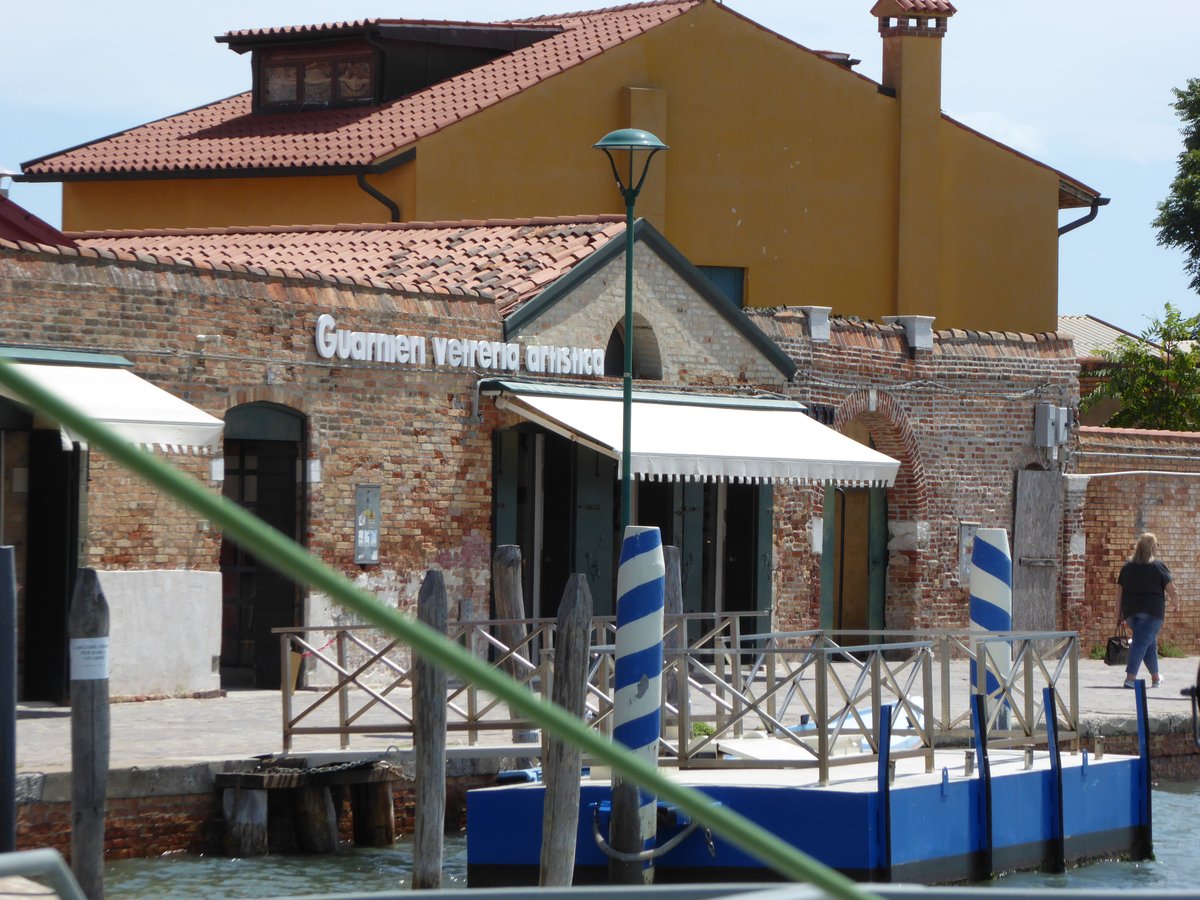
The vaporetto docks at Faro. Five minutes crossing from Fondamente Nove, and you’re on another planet. Murano looks like Venice in miniature: canals, bridges, pastel facades. But the air is different. Hotter. Heavier. It smells of heated metal, burned gas, cooled sweat. At least, it used to. Today, many chimneys no longer smoke.
A Thousand Years of Fire
In 1291, the Grand Council of Venice decreed that all glass furnaces in the city must be moved to the island of Murano. Official reason: fire risk. Real reason: controlling the glassmakers. Their manufacturing secrets were worth gold. The Republic wanted them under watch.
The decree created a gilded ghetto. Murano’s master glassmakers enjoyed considerable privileges: they could carry swords, their daughters married nobles. But they had no right to leave the island. Those who tried to flee with their secrets risked death. Their families too.
For seven centuries, it worked. Murano dominated the world glass market. Cristallo, developed by Angelo Barovier in the fifteenth century, was the purest, most transparent glass in Europe. Venetian mirrors, chandeliers, millefiori beads, gold-threaded blown glass: all of it came from this archipelago less than two kilometers across. The courts of Europe bought from Murano. Imitators tried, failed, tried again.
The secret lay in chemistry as much as in the gesture. Sand from the lagoon, ashes of halophyte plants for soda, manganese for decolorization, metal oxides for color. And then the hands. Hands that know how to turn the blowing rod to the exact second, that sense when the glass is ready, that read the material like a musician reads a score. This knowledge cannot be written down. It passes from master to apprentice, in the heat of the furnaces, over ten, fifteen, twenty years.
The Island Empties
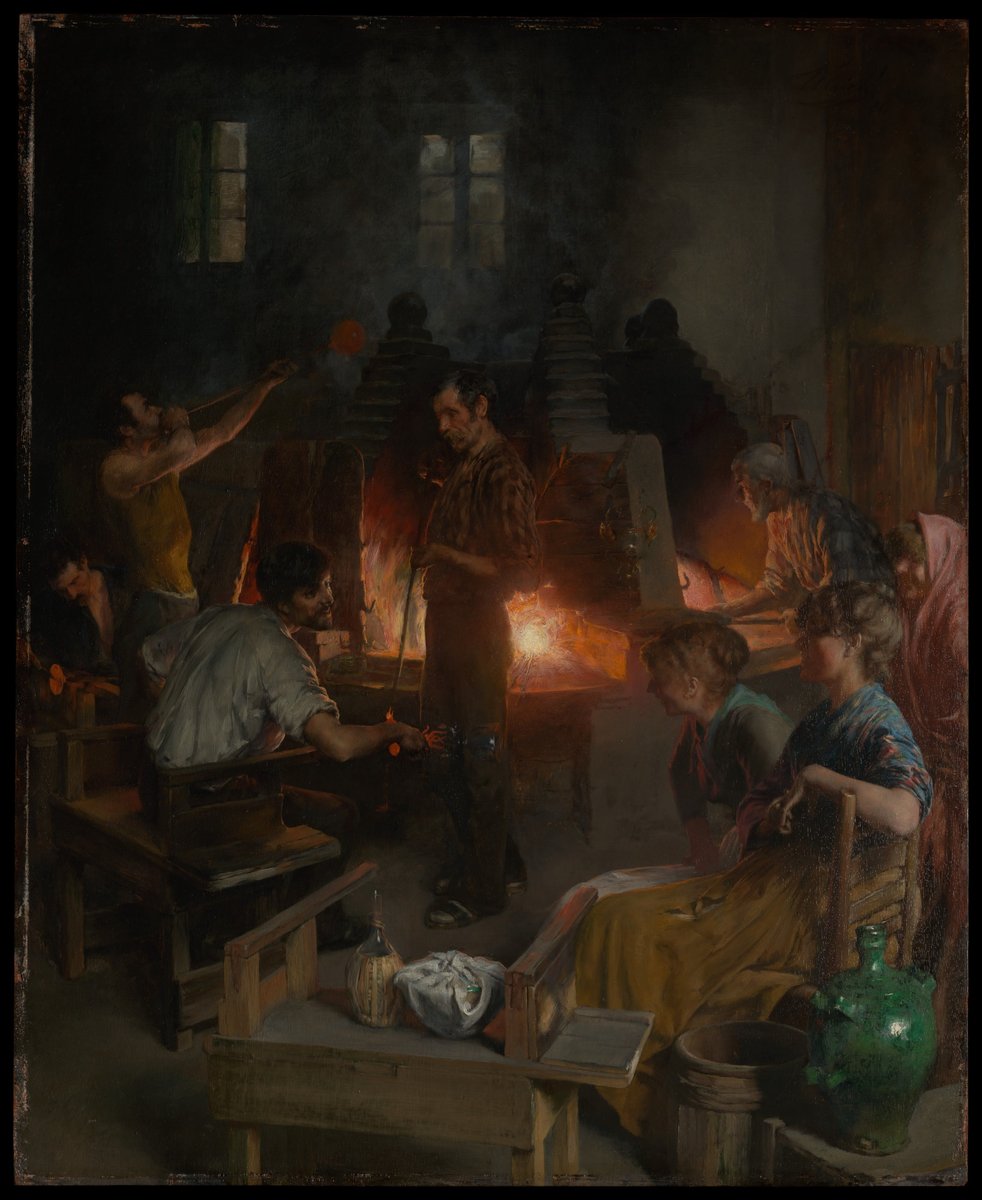
In 1990, Murano had over a hundred active furnaces. Glassmaking dynasties (Barovier & Toso, Venini, Seguso, Salviati) produced alongside dozens of smaller workshops. The island employed thousands. Murano glass was exported worldwide.
In 2024, the Consorzio Promovetro Murano counted 64 active furnaces and 87 secondary processing firms, for a total of 151 entities and 1,242 employees. Far fewer than the hundreds of workshops of the last century. And the 2022-2023 energy crisis accelerated the bleeding: gas prices quadrupled in a few months, pushing several workshops to shut down their furnaces, some permanently.
The numbers are merciless. Murano’s furnaces run on natural gas, continuously, day and night. At the peak of the crisis in 2022, some workshops saw their bills jump 400% in a single year, according to master glassblower Giancarlo Signoretto’s testimony to Euronews. For businesses whose annual revenue rarely exceeds a few million euros, that is the difference between survival and closure.
Some held on by cutting production. Others temporarily shut down their furnaces, a dramatic move when you consider that a cooled furnace takes months to restart and tens of thousands of euros to refit. A few never relit theirs.
Industrial Counterfeiting
Gas is not the only problem. There is also what gets sold on the island itself.
Walk along the Fondamenta dei Vetrai, Murano’s main street. Shops line up, windows filled with rearing horses, multicolored clowns, chandeliers, jewelry. Prices range from five euros to five thousand. And a significant share of what is on display has never seen a Murano furnace.
The problem has been documented for years. In 2021, the Guardia di Finanza seized batches of glass pieces imported from China and sold as “Murano glass” in shops on the island. Objects industrially manufactured in Yiwu or Wenzhou, shipped by container, hand-labeled once unloaded in Italy.
The “Vetro Artistico Murano” label, created by the Veneto Region, is supposed to guarantee origin. A hologram, a serial number, a registry. But the label is voluntary, not mandatory. The Veneto regional law (no. 70/1994) covers artistic glass, beads, conterie, and murrine. The problem lies elsewhere: the label remains voluntary, and a considerable share of objects sold to tourists escapes any oversight.
The result is predictable. The average tourist cannot tell a Murano-blown glass from a Chinese mold. They buy on price, they buy on volume, they leave happy. The artisan who spent twenty years learning the craft ends up competing with a Guangdong factory that produces the same shape for a tenth of the cost.
For the buyer who wants the real thing, a few markers. The Vetro Artistico Murano label (hologram + serial number) is the only official guarantee, even if it remains voluntary. Without the label, the signs are physical: hand-blown glass shows slight asymmetries, variations in thickness, sometimes a trapped air bubble. The base often bears the pontil mark, the scar left by the blowing rod. An industrial mold is perfectly regular, perfectly smooth, perfectly dead. The difference can be seen, felt, and above all weighed: Murano glass is lighter than it looks.
Those Who Stay
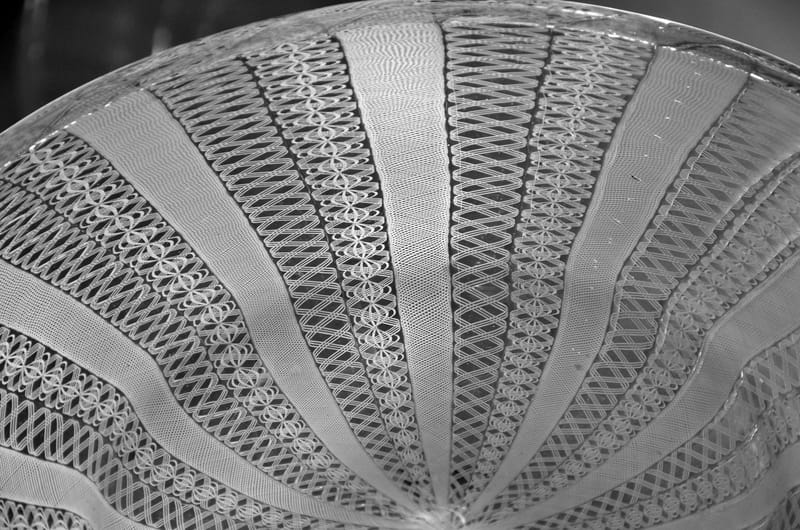
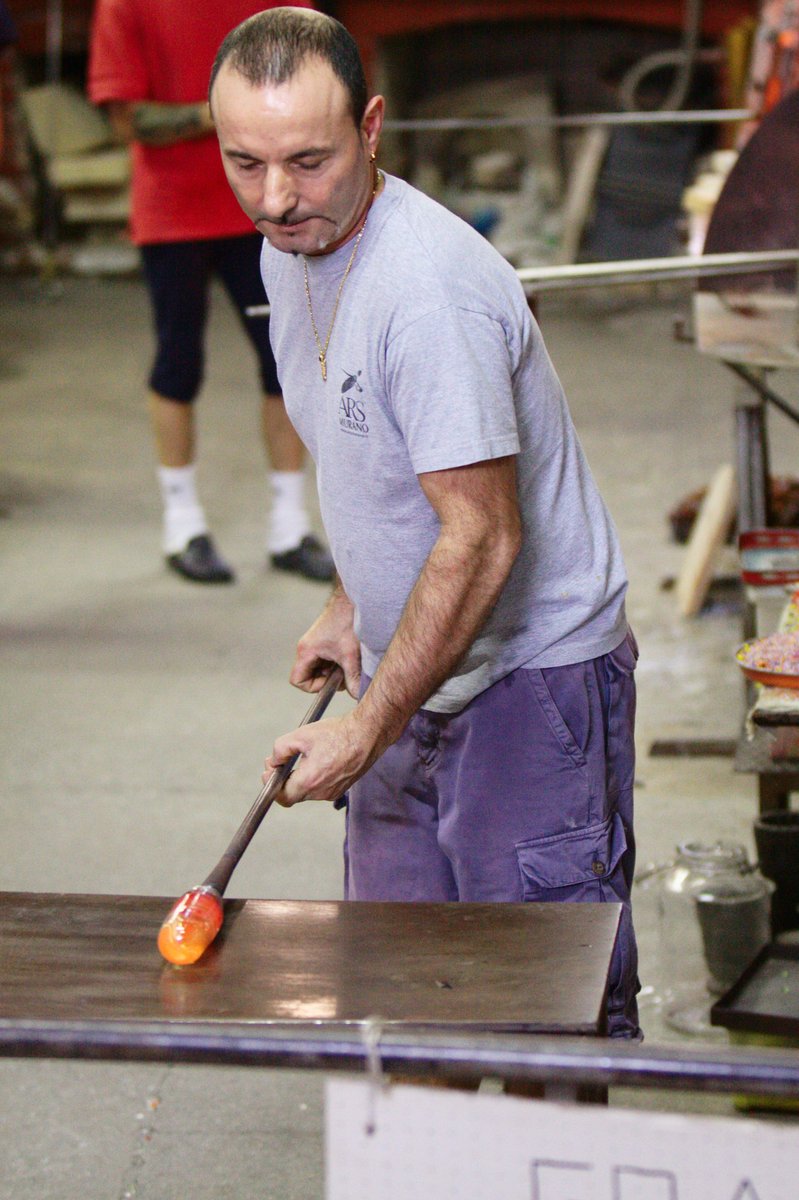
In his workshop on the Rio dei Vetrai, a maestro (let’s call him M.) has been blowing glass for forty years. He learned from his father, who learned from his. He is one of the few Murano masters still capable of making a Venetian-style filigree goblet, a technique that traps colored glass threads in a transparent matrix, creating patterns of staggering complexity.
The filigrana technique demands coordination between the maestro and his assistants (the servente who prepares the rods, the garzonetto who turns the pontil) that amounts to choreography. One gesture too many, one second too late, and the piece is lost. There is no ctrl+Z in blown glass.
M. is sixty-three. His workshop employs four people. His son works in IT in Mestre. His daughter lives in Milan. Neither will take over the workshop.
“The problem isn’t finding young people,” he says. “The problem is that training takes ten years and nobody can afford it. Ten years learning, paid as an apprentice, in 1,200-degree heat. The young ones who come stay six months and leave.”
The Abate Zanetti, Murano’s glass school founded in 1862, still trains students. But the classes are tiny. And most graduates don’t stay on the island. They go elsewhere to practice: the United States, Scandinavia, Australia, places where a Murano-trained glassblower is a selling point.
The Event, and After
Murano Illumina il Mondo, the event meant to remind the world that Murano still exists, ended in March 2026. For several months, light installations showcased the glassmakers’ work. Tourists came. Photos circulated on social media. Press articles spoke of “renaissance.”
That is always the word. Renaissance. As if simply talking about it were enough to reverse the trend. But cultural events don’t pay gas bills. Light installations don’t keep furnaces warm. And enthusiastic articles don’t train apprentices.
What Murano lacks is not spotlights. It is a viable economic model for the twenty-first century.
What Could Change
A few initiatives exist. The Consorzio Promovetro and various local associations try to coordinate preservation efforts. Documentation programs film the maestri’s techniques: useful for the archive, insufficient for transmission. Some workshops have turned to contemporary art, collaborating with designers and artists to create high-value pieces that justify production costs.
Venini, owned by the Italian group Damiani since 2016 (sole shareholder since 2020), may be the most interesting example. The company continues to produce on the island but positions itself exclusively at the high end: pieces signed by international designers, sold in art galleries rather than tourist shops. The model works. But it only saves Venini. The dozens of more modest workshops that produced quality artisanal glass for the mid-range market do not have that card to play.
The energy transition could help. The Italian government created a support fund for artisanal ceramics and Murano glass, endowed with 1.5 million euros in 2023, to offset energy surcharges. Some mention eventually electrifying the furnaces, which would reduce both costs and carbon footprint. But the glassmakers are skeptical. The gas flame, they say, gives the glass a quality that electric heating cannot reproduce. Heat distribution is different. The material behaves differently. This is not conservatism. It is physics.
The Real Question
Murano raises the same question as every threatened craft, from Thiers to Sakai, from Arques to Wajima. A simple question, to which nobody has a satisfying answer: how do you keep alive a craft whose production costs are incompatible with the market?
You can subsidize. The Italian government already does. But subsidies create dependency, not a solution. You can certify. The Vetro Artistico Murano has existed for years. But a label without enforcement is a label without value. You can grant heritage status. The art of Venetian glass beads was inscribed on UNESCO’s Intangible Cultural Heritage list in 2020. But a heritage inscription pays neither the gas, nor the salaries, nor the training of apprentices.
What will save Murano, if anything can, is not a political gesture, a label, or an event. It is the glassmakers’ ability to find clients willing to pay the real price of an object made by hand, by a master, on an island where fire has burned for a thousand years.
Murano glass needs neither marketing nor storytelling. It needs fire. And fire, on the glassmakers’ island, costs more every year.
What Is Really Going Dark
Restarting a Murano furnace after a shutdown takes months, not days. The ceramic crucible, held at over 1,000 degrees during operation, cracks as it cools and must be replaced. The brick facade of the furnace has to be dismantled, a new crucible installed, the whole thing rebuilt, then brought back up to temperature slowly. As Giancarlo Signoretto explained to Euronews: “Shutting down temporarily never means a few weeks. It means several months at least.”
When a workshop closes, it is not just a furnace that goes dark. It is a chain of transmission that breaks. The maestro who leaves takes with him gestures nobody filmed, reflexes nobody documented, intuitions nobody formalized. Blown glass is not learned from books. It is learned by watching, by imitating, by failing, for years.
Murano has survived invasions, epidemics, Napoleon, two world wars. It has survived competition from Bohemia, England, Sweden. It has survived its own decadence, when mass tourism turned the island into a bazaar.
It may not survive a gas bill.