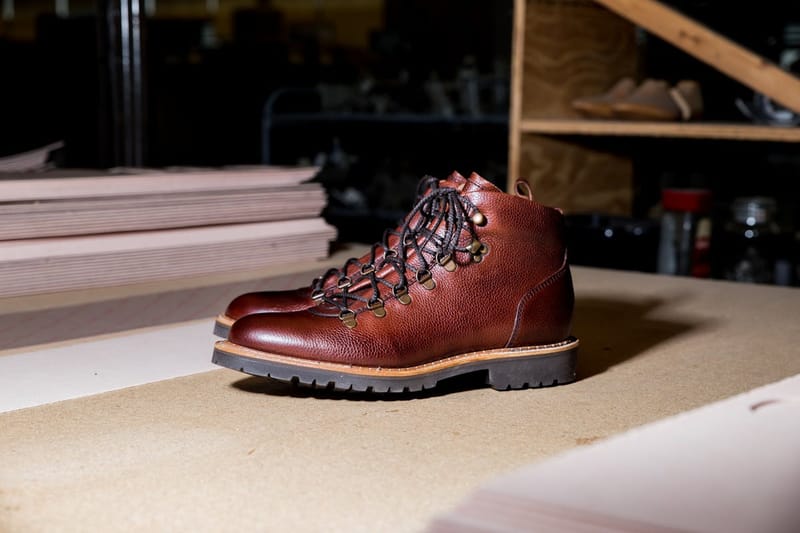
I remember the exact price of my first pair of Red Wing Iron Rangers. 280 dollars. It was 2015. I hesitated for two weeks before buying them. Nearly three hundred dollars for boots felt like a lot.
The same pair costs around 350 dollars today. A twenty-five percent increase in ten years.
An Alden Indy went from 500 to 750 dollars. Viberg, from 700 to over 900. Across the heritage segment, price tags have been climbing steadily. And the same question keeps coming up among enthusiasts: what justifies this?
This is not an article against high prices. It is an essay to understand them. And to distinguish, behind the price tag, what comes from real costs and what comes from opportunism.
Leather, or the art of paying for raw materials
Let’s start with what you can touch: the leather.
A Chromexcel hide from Horween, in Chicago, now costs between 10 and 15 dollars per square foot wholesale, depending on thickness and order volume. Ten years ago, it was half that. Horween has been tanning in the same building since 1920, using slow processes, wooden vats, and tanners who know each hide by its grain. It is not a factory - it is a workshop that smells of tallow and patience.
Shell cordovan - the horse rump leather that Horween is one of the last tanneries in the world to master - has doubled in price over ten years. Understandably: tanning takes a minimum of six months, raw hides are becoming scarce, and global demand is surging. Each hide yields only two small pieces of cordovan, one from each side of the rump. The rest is waste.
In Japan, Shinki Hikaku produces artisanal cordovan in even more limited quantities. In England, C.F. Stead supplies suedes and oiled leathers of remarkable quality. These tanners are not interchangeable. You cannot replace Chromexcel with generic leather without it showing and feeling different.
When a brand tells you that prices are rising because of leather, check which leather first. If it is Horween, Shinki Hikaku, or C.F. Stead, there is a good chance it is true. Quality leather has genuinely increased in price, and significantly so. If it is a nameless leather, tanned who knows where, the increase deserves more questions.
Sewing a Goodyear welt: how many hours?
Take a boot in Goodyear welt construction. It is the standard of the heritage segment - the method that allows indefinite resoling.
The principle is simple to explain, long to execute. A leather welt strip is stitched to the upper and the insole. The outsole is then stitched to that welt. Two separate seams, an air chamber between them that insulates and cushions.
At Tricker’s, in Northampton, a pair goes through 260 manual operations. The factory is a listed historic building. Workers have been at the same stations for decades. The craftsmanship is real, slow, and expensive.
At White’s Boots or Nick’s, in Spokane, Washington State, stitchdown construction is still sewn by hand. Not by machine - by hand. A skilled worker spends several hours on a single pair. In the United States, the hourly cost of an experienced craftsman in the Pacific Northwest exceeds 35 dollars. In England, it is somewhat less. In Japan, it varies, but the precision required extends production times.
At Clinch, in Tokyo, four craftsmen produce between 800 and 1,000 pairs per year. Do the math: that is one pair per craftsman every two days. Each boot is built like a piece of fine jewelry, in Goodyear welt, from hand-selected vegetable-tanned horse leather. At that production level, the per-unit labor cost is considerable.
Viberg, in Victoria, British Columbia, counts over 200 steps per pair in stitchdown construction. Glenn Viberg, the father of the current owner, still finishes every pair that leaves the workshop. Three generations, one address.
Skilled labor is the cost that has risen the most. Not because craftsmen have become greedy. Because they have become rare. Training a Goodyear welt laster takes years. And the next generation is not exactly lining up.

The margin: the invisible equation
Here is a number the industry does not like to show: in a traditional retail distribution chain, the retail price is four to five times the production cost. The brand applies a markup of 2 to 2.5 to cover its costs and generate margin. The retailer applies its own, also between 2 and 2.5. A product that costs 100 dollars to make ends up at 400 or 500 in store.
This is the norm, not the exception. And it is true for Red Wing just as for a boutique brand.
The difference is what each puts into that 100 dollars of production. Horween leather or anonymous leather. A Goodyear welt made in Northampton or gluing done in Asia. Twenty minutes of labor or eight hours.
Some brands have figured out that by selling direct, they can cut out the middleman. Nick’s Boots, for example, sells most of its production through its website. No retailer, no intermediary margin. The price remains high, but a much larger share actually goes into the boot.
Paraboot, which produces 600 pairs per day in Saint-Jean-de-Moirans with its own natural rubber soles, controls its entire chain. From sole to point of sale. That is one of the reasons the value proposition remains coherent despite prices that have also risen.
J.M. Weston goes even further: the brand owns its own tannery and controls every step, from raw leather to finished shoe. 150 steps per pair, in the workshops of Limoges. It is a rare vertical integration in the industry, and it is also part of what justifies the price.
When prices rise for no reason
Everything I have just described is the justified increase. Leather costs more, labor costs more, tanneries are closing, craftsmen are retiring. It is documented, it is measurable.
And then there is the other kind of increase. The one that has nothing to do with any of that.
Some heritage brands have raised their prices by 40 to 60 percent in five years without changing a single thing about the product. Same leather, same factory, same construction. Sometimes even a slight decline in finishing, noted by enthusiasts who compare their new pairs with ones purchased a few years earlier.
The mechanism is simple. A brand earns a reputation, a status within the community. Demand increases. Instead of increasing production, they increase the price. The product becomes a social marker rather than a tool. The price tag does the work that leather used to do.
Enthusiasts see it. They compare. They measure leather thickness, check stitch consistency, inspect insoles. When a brand raises prices while switching from stitched to glued construction on certain models, word gets around. When finishing declines while prices advance, people talk.
It is a sensitive topic. There is a kind of breach of trust when a brand that was built on product honesty starts playing the premium positioning game. The enthusiasts who wore these boots on job sites and in forests do not read things the same way as new customers buying them to wear with raw denim at the office.

The benchmarks: what is a fair price?
Here is what I have learned from buying, wearing, and comparing boots for years. These are not absolute truths, but reference points.
Entry-level heritage (250-400 dollars). This is Red Wing territory. Goodyear welt construction, leather tanned in-house (Red Wing has owned S.B. Foot Tanning since 1986), American-made. At this price, you get a real boot - resoleable, in honest leather. It is the best value in the segment. If the price goes above 450 dollars without any product evolution, something is off.
Mid-range (400-700 dollars). Tricker’s in Northampton, Paraboot in Isere, White’s in Spokane. Impeccable construction, superior quality leathers, workshops with real history. Prices here are justified by skilled labor and materials. This is the heart of the heritage market.
High-end (700-1,200 dollars). Viberg, Nick’s in custom configuration, special edition Tricker’s. You are entering the territory of top-tier craftsmanship. Rare leathers, limited runs, extensive customization. The price gap from mid-range is justified by materials and production scarcity, not marketing.
Ultra-premium (above 1,200 dollars). Clinch, Viberg in heavy shell cordovan, J.M. Weston. Here, you are paying for the craft in its most refined form. Four craftsmen for 800 pairs a year at Clinch - that is haute couture applied to boots. The prices are staggering, but the product lives up to them.
If a price seems high, ask three questions. Where is it made? By how many people? With what leather? If the answer is precise, detailed, and verifiable, you are probably looking at something solid. If the answer is vague, if the website talks about “premium leather” without ever naming the tanner, if manufacturing is “European” with no further detail - be skeptical.
The knifemaker’s VG-10
A parallel comes to mind from the knife world. For years, VG-10 steel was the benchmark. Then American steels like S35VN arrived, and VG-10 started to look dated. Some makers continued to sell it at the same price, or even higher, capitalizing on past reputation.
Leather works the same way. Horween Chromexcel remains excellent. But when a brand charges shell cordovan prices for Chromexcel, or Chromexcel prices for generic leather, it is selling a reputation, not a material.
Enthusiasts have formidable memories. They keep their old pairs and compare them to new ones. They measure, they document, they share. The slightest decline in quality eventually comes to light. And in a niche market where word of mouth is everything, lost trust is nearly impossible to regain.

Buy less, understand more
I did not write this article to discourage you from buying expensive boots. I own several pairs myself that are well past the threshold of reasonable.
I wrote it so the price tag is no longer a mystery. So that when you look at a price, you can break down what goes into the leather, what goes to the craftsman’s hand, what goes into the retailer’s margin, and what goes into thin air.
The best boots in the world are expensive because they are made by people who know what they are doing, with materials that take time, in workshops that refuse to cut corners. At Viberg, Tricker’s, Clinch, White’s, Paraboot - there is a direct link between price and product.
Others are expensive because they can be. Because the brand has reached a threshold of desirability where price becomes an argument in itself. The boot has not changed. The price tag has.
The difference between the two is measured in leather, in stitches, and in transparency.
A good boot should be able to justify itself without needing its logo.