
France grows the world’s flax but has forgotten how to spin it
On September 22, 2025, twenty-three employees switched off the machines at the Safilin spinning mill in Béthune. Three years after its high-profile reopening, the last linen spinning mill in Hauts-de-France closed its doors. No buyer, no plan B. Just a polite press release, subsidies to repay, and a reality nobody wants to spell out: France, the world’s leading flax producer, is incapable of processing its own fiber.
This is not an industrial accident. It is a structural admission of failure.
A country that harvests for others
The numbers are stark. France cultivates nearly 150,000 hectares of fiber flax - roughly 85% of European acreage and over 60% of global production. From Normandy to Hauts-de-France, flax grows better here than anywhere else on earth. The maritime climate, silty soils, agricultural know-how passed down for centuries: everything aligns.
Except that France no longer spins.
After harvest, the stems are retted in the fields, then scutched in local mills that separate the fiber from the straw. So far, so good. It is the next step that has vanished: spinning, the industrial process that turns raw fiber into yarn usable by weavers. And without spinning, there is no fabric. No garment. No added value.
The result: 80% of French flax leaves the country as raw fiber. Destination: China, Poland, the Baltic states. There it is spun, woven, sometimes sewn into garments, then shipped back to Europe as shirts, sheets, or tablecloths labeled “European linen.” The flax travels 20,000 kilometers before returning to a Parisian shop.
This is the founding paradox of the industry: France controls the agricultural upstream but has abandoned the industrial downstream. It exports a noble raw material only to buy it back transformed, at a premium, with a disastrous carbon footprint.
Safilin: 250 years of history, two years of reprieve
The story of Safilin is the story of French linen in miniature. Founded in 1778, granted a royal patent in 1786, the Maison Salmon spun flax in northern France for two centuries. At its peak, around 1900, a thousand workers operated four sites between Nord and Pas-de-Calais.
Then came the decline. Competition from cotton, the explosion of synthetic fibers, globalization. In the 1970s, Safilin dropped weaving to focus on spinning. But it was not enough. Between 1995 and 1997, the Salmon family relocated production to Poland, in the Masuria lake district. Two factories - Szczytno for wet spinning (2,000 tonnes/year), Miłakowo for dry spinning (2,500 tonnes/year) - capable of producing roughly 4,500 tonnes of yarn annually. Labor cost four times less. The deal was done.
In France, the last linen spinning mills closed by the late 1990s. All of them. The know-how vanished along with the workers. The Lys valley, the historic cradle of linen straddling France and Belgium, no longer spun a single gram.
The relocation mirage
Twenty years later, in 2021, the wind appeared to shift. The France Relance recovery plan poured billions into reindustrialization. “Made in France” was fashionable. Textile brands were hunting for short, traceable, narratable supply chains. Flax - the quintessential ecological fiber (low water use, few pesticides, locally grown) - ticked every box of virtuous marketing.
Safilin decided to reopen a spinning mill in France. Béthune, Pas-de-Calais - a homecoming. Five million euros of investment, including 800,000 euros from France Relance plus grants from the Hauts-de-France region and the local agglomeration authority. A logistics warehouse was converted into a production unit. Target: 250 to 400 tonnes of yarn per year, 100% spun in France.
In June 2022, the first kilogram of linen yarn came off the machines. Twenty-three workers were hired. The local press went wild. Officials posed for photos. Safilin embodied successful reshoring - proof that it could be done.
Except it could not be done. Not under those conditions.
Autopsy of a foretold failure
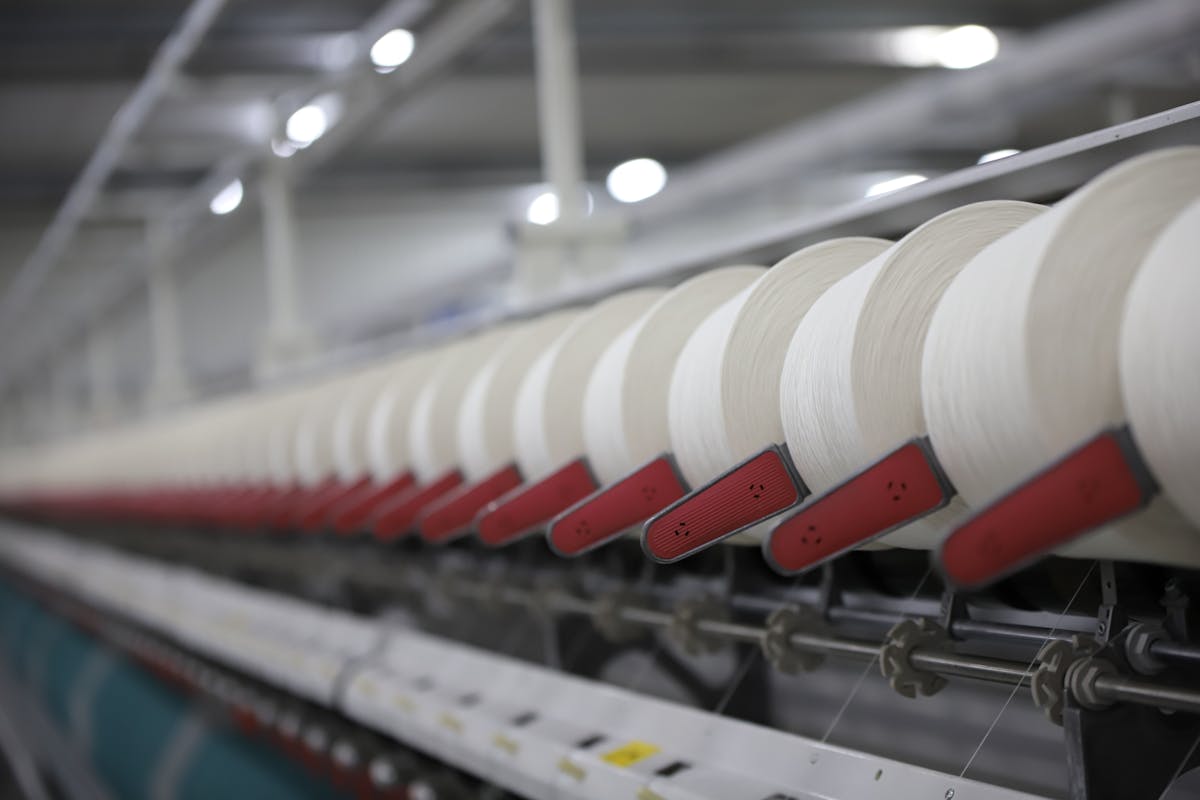
The Béthune mill produced 250 tonnes in the best case. Safilin’s Polish factories produce 4,500. The ratio is one to eighteen. The French unit was not an industrial tool - it was a demonstrator, a political prototype funded with public money.
The problems piled up. First, harvests: 2023 and 2024 brought weather disruptions that drove up raw fiber costs. Then energy: wet spinning is energy-intensive, and costs surged after 2022. And above all, the market. Linen yarn spun in France costs more than yarn spun in Poland or China. Faced with fast fashion, the brands that had promised to “source locally” made their trade-offs. Price won.
On September 22, 2025, Safilin closed Béthune. The company had to repay 400,000 euros to the region and 100,000 euros to the agglomeration authority. The 23 employees were laid off. Polish production carried on as if nothing had happened.
“The 23 employees rose to the occasion - it is heartbreaking,” management told France 3. No one doubts the sincerity. But heartbreak is not an industrial strategy.
Other attempts: fragile, tiny, isolated
Safilin was not alone in trying. In 2020, the Velcorex group, through its subsidiary Emanuel Lang, installed a small dry spinning line in Hirsingue, Haut-Rhin. Capacity: 150 tonnes per year. In 2022, the agricultural cooperative NatUp inaugurated its “French Filature” in Saint-Martin-du-Tilleul, Eure, in Normandy. Capacity: 250 tonnes per year. In Brittany, the Linfini project promises a spinning mill near Morlaix.
These initiatives exist. They are courageous. But they remain micro-scale artisanal units in a global market that operates on a scale of thousands of tonnes. Poland spins. China spins. Lithuania spins. France inaugurates production lines that do not even cover 1% of its own crop’s processing needs.
More critically, every one of these French mills depends on the same gamble: that brands will accept a premium for yarn certified “origin France.” A gamble that, as Safilin has just demonstrated, does not hold up against market realities.

The real problem: a missing link for thirty years
The question is not whether French flax is good. It is the best in the world. Nor is the question whether reshoring is desirable. It is - for employment, for the climate, for industrial sovereignty.
The question is: why has a country that produces 60% of the world’s flax been unable to sustain a single viable spinning mill in thirty years?
The answer fits in three words: no industrial policy.
While France let its spinning mills die in the 1990s, Poland invested in textile infrastructure. China built mega-factories. India moved upmarket. And France simply kept growing flax and exporting it raw, like a Global South country exporting cocoa beans without ever making chocolate.
The France Relance plan handed out checks. But a check for 800,000 euros does not replace thirty years of vanished industrial fabric: the skills, the subcontractors, the training schools, the maintenance networks, the economies of scale. You do not rebuild an industry with press releases.
What now?
French flax will keep growing. Farmers in Normandy and Picardy will keep sowing, harvesting, and scutching. And 80% of their output will keep leaving in containers bound for China and Poland, where it will be processed at lower cost before returning to clothe the French.
Safilin will keep spinning - in Poland. The Szczytno and Miłakowo factories continue production. The company remains a leading European spinner, with roughly 350 employees and revenue of around 22 million euros (2024). It simply no longer spins in France.
The flax paradox is that of all French industry: a country that knows how to produce the raw material but has forgotten how to transform it. A country that mistakes reshoring for a PR stunt, that inaugurates factories without asking whether they can survive beyond the first fiscal year, and then acts surprised when reality fails to match the press kit.
Twenty-three people knew how to spin flax in Béthune. They will not do it again. And in ten years, when another government plan promises to “reindustrialize the flax sector,” everything will have to start from scratch. Once more.