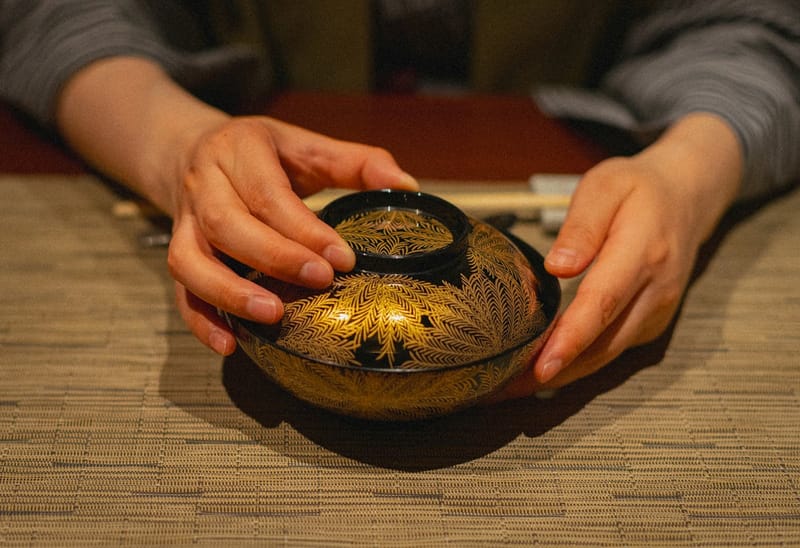
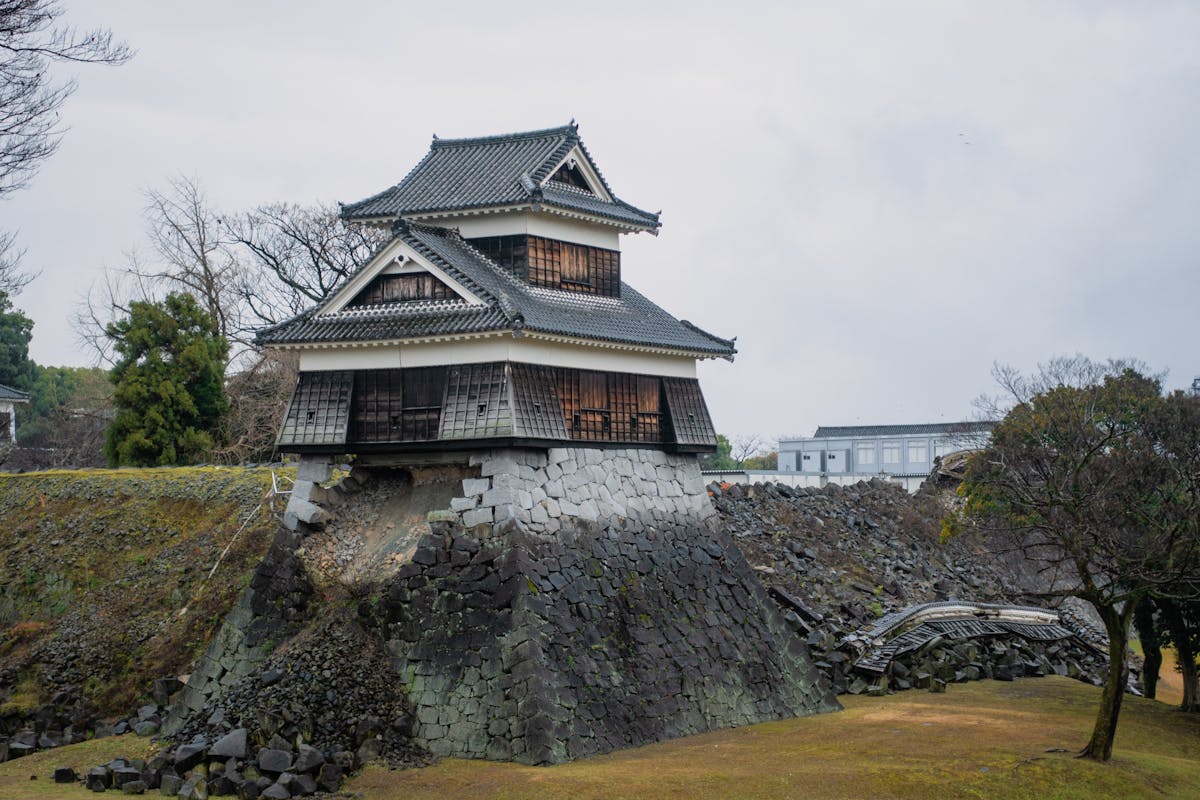
On January 1, 2024, at 4:10 PM local time, the Noto Peninsula shook. Magnitude 7.6. The epicenter was thirty kilometers from Wajima, a small city of 23,000 inhabitants on the northern coast of the Sea of Japan. In seconds, walls four centuries old collapsed. Kilns toppled. Hundreds of pieces in the process of drying, some after their twentieth coat of lacquer, shattered on the floor. The Asaichi, the centuries-old morning market, burned in the fire that followed. That day, Wajima didn’t just lose buildings. It lost hands, tools, gestures.
Four centuries of lacquer
Wajima-nuri is a lacquerware craft designated among the traditional techniques recognized by Japan’s Ministry of Economy, Trade and Industry since 1975. This designation is not honorary. It acknowledges a codified manufacturing process, transmitted from master to apprentice since the early Edo period.
The technique rests on a simple but demanding principle: applying natural lacquer, urushi, the sap of the Toxicodendron vernicifluum tree, in successive layers on a wooden base. Each layer dries slowly in a humid, controlled environment, the furo, a drying cabinet maintained between 65 and 80% humidity. No heat. Urushi polymerizes through humidity. Twenty to thirty layers for a standard piece. Over a hundred for ceremonial items. Each layer requires one to several days of drying. A single bowl can take six months of work.
What distinguishes Wajima from other Japanese lacquer centers (Aizu-Wakamatsu, Tsugaru, Yamanaka) is the use of jinoko, a locally extracted diatomaceous earth powder, mixed with lacquer to reinforce the undercoat. This technique, unique to Wajima, gives pieces a durability that other lacquers cannot match. A Wajima-nuri bowl can last generations. It doesn’t crack. It doesn’t chip. It ages.
The complete process involves a division of labor across more than a hundred steps, distributed among the kijishi (wood turner), the nushishi (intermediate coat lacquerer), the uwanurishi (finishing lacquerer), the makieshi (decorator using gold or silver powder), and the chinkinshi (engraver of inlaid gold leaf). Each specialty is a trade in its own right. Each master commands only their own.
What the earthquake destroyed
The human toll of the Noto earthquake continues to grow: more than 700 dead to date, including 228 directly linked to the earthquake and several hundred indirect deaths caused by evacuation conditions. In Wajima, the material toll on the craft is staggering. According to figures reported by Ishikawa Prefecture and the Wajima Lacquerware Cooperative, more than 90% of workshops sustained damage. Many of them collapsed or were rendered unusable.
The losses cannot be measured only in walls and roofs. Artisans lost tools passed down across generations: brushes made from human hair whose very manufacture is itself a dying art, irreplaceable polishing stones, reserves of urushi aged for years to reach the right consistency. Urushi is not manufactured. It is harvested, drop by drop, by scoring the bark of trees that take fifteen years to produce. To lose a stock of aged lacquer is to lose time that cannot be recovered.
Pieces in production were the hardest hit. Lacquer demands uninterrupted progression: if drying is disrupted, if a piece falls, if dust infiltrates a fresh layer, weeks of work are lost. Hundreds of bowls, trays, and incense boxes were found cracked, crushed under rubble, covered in debris.
Before the earthquake, the city had approximately 700 artisans, according to the New York Times, most of whom worked in workshops set up in their homes. The entire city functioned as an interconnected workshop. This was already a fraction of what Wajima counted in the 1980s, when production reached its commercial peak. The earthquake accelerated a demographic decline that no one had managed to slow. In the weeks that followed, artisans left. Some for Kanazawa, two hours away by road. Others for cities in the Kansai region. A few did not say where they were going.
Shigeru Ban and the paper workshops
Shigeru Ban arrived in Wajima in the spring of 2024. The Japanese architect, 2014 Pritzker Prize laureate, is known for his emergency structures made from cardboard tubes. He built them after the Kobe earthquake in 1995, after the 2011 tsunami, in Rwanda, in Turkey. His material of choice is the reinforced paper tube: lightweight, recyclable, quick to assemble, surprisingly sturdy.
In Wajima, Ban designed temporary workshops for the lacquer artisans. Modular structures made of cardboard tubes and local wood, assembled in a few days, capable of housing the drying kilns and workstations. The idea was not to rebuild identically (the old workshops were often century-old wooden houses, impossible to reproduce quickly) but to allow the artisans to resume work before the gesture was lost.
Because that is the real risk. An artisan who does not practice for a year loses sensitivity. Urushi is worked by touch: the thickness of each layer is judged by the resistance of the brush on the surface, by the viscosity of the lacquer between the fingers, by the wet sheen that signals the right moment to move to the next step. This sensory memory fades. Stillness is the enemy of the gesture.
The Ban workshops allowed artisans to resume production by the spring of 2024. Temporary by nature, they are designed to be dismantled when permanent reconstruction is complete. But in Wajima, nothing happens fast. Two years after the earthquake, the city’s reconstruction progresses slowly. The roads of the Noto Peninsula, damaged by landslides, remain partially impassable. The artisans work in temporary workshops, waiting for a return to normal that no one can date.
Kintsugi: repairing what is broken
In the rubble of the workshops, the artisans found fragments. Pieces of lacquered bowls, shards of tea boxes, broken items some of which carried twenty layers of lacquer applied over weeks. Ordinarily, these fragments would be waste. But in Wajima, someone had an idea.
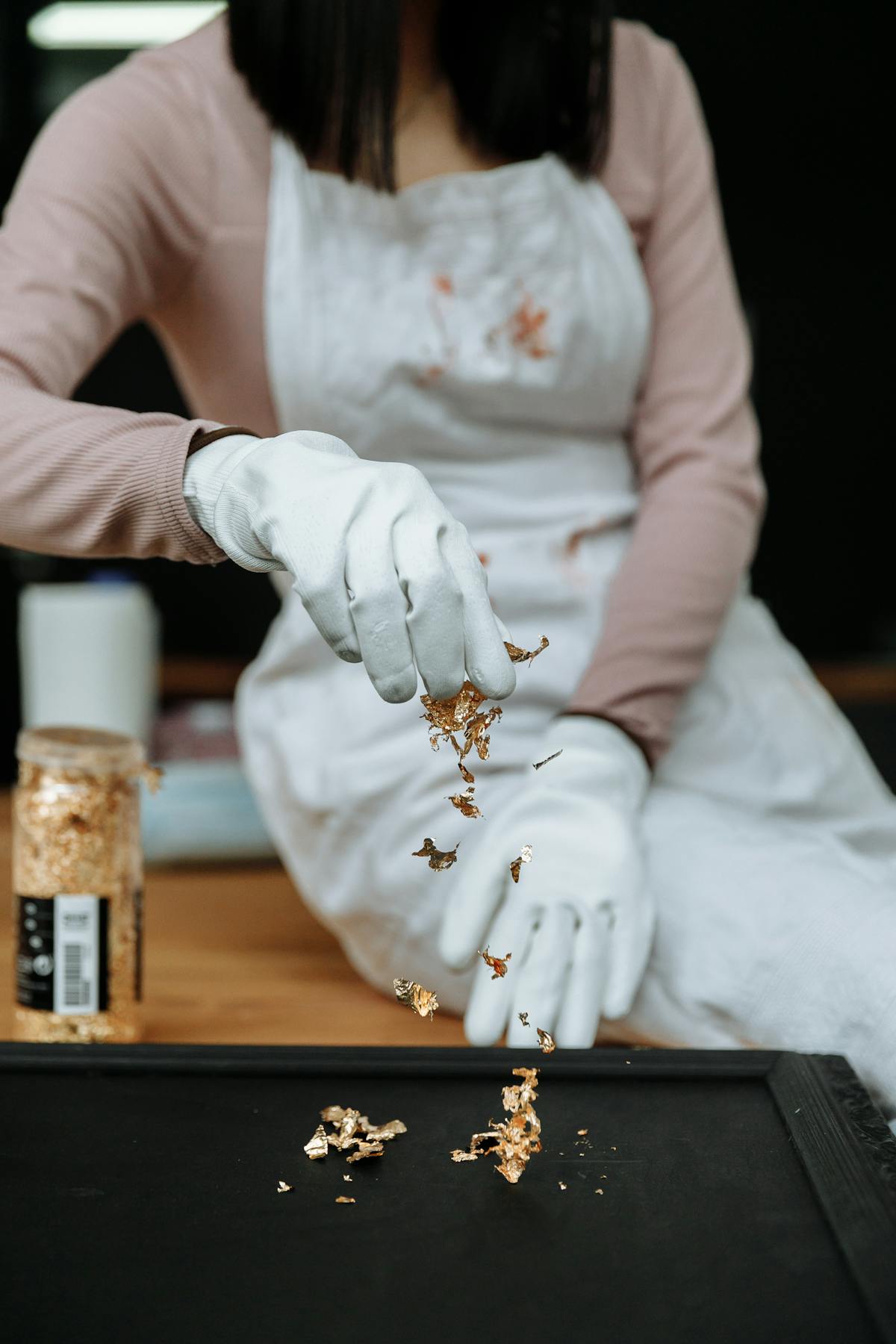
Kintsugi, the art of repairing broken ceramics with lacquer mixed with gold powder, is as much a philosophy as a technique. It asserts that the break is part of the object’s history, that repair does not erase the wound but elevates it. A bowl reassembled through kintsugi is more beautiful than before its fall. Its gold veins tell the story of what it has endured.
Artisans in Wajima began applying this logic to their own pieces destroyed by the earthquake. They assembled fragments of broken lacquerware, joined them with gilded urushi, and created new objects from ruins. A bowl whose one half comes from a collapsed workshop and the other from a piece recovered from the rubble. A tray whose gold veins follow the fracture lines of the earthquake. Each piece carries the memory of January 1, 2024.
These kintsugi pieces were presented at exhibitions in Tokyo and Kanazawa. They are not for sale. They are not products. They are testimonies.
The Expo Osaka globe
In April 2025, the World Expo opened its doors in Osaka on the artificial island of Yumeshima. The theme: “Designing Future Society for Our Lives.” Among the exhibited pieces, a one-meter-diameter Wajima-nuri lacquered globe titled “Earth at Night.”
The globe is covered in black lacquer, roiro-nuri, the mirror finish that is Wajima’s signature, and studded with luminous points in maki-e, the decorative technique using gold powder. The points represent the lights of cities seen from space. Japan shines at the center. Wajima is there.
The piece was not created after the earthquake. It existed before. According to the official Expo communique, the globe “miraculously remained intact” during the earthquake of January 1, 2024. That is precisely what makes it a symbol: an object of apparent fragility, survivor of a magnitude 7.6 earthquake, turned emblem of reconstruction. The Expo association and the Ministry of Economy chose it to embody “the importance of thinking of others beyond conflicts and divisions.”
The globe is not merely a work of art. It is a survival. Wajima says: we are still standing. We can still do what no one else knows how to do.
2027: a training center
Ishikawa Prefecture has announced the creation of a training institute dedicated to Wajima lacquerware, with a target opening for fiscal year 2027. The project, reported by the Japan News, will admit approximately five apprentices under 40 each year for multi-year training in the various specialties.
The challenge is arithmetic. The trade is aging, and the next generation is slow to arrive. Full training for a lacquerer takes between five and ten years depending on the specialty. If the first apprentices begin training in 2027, they will not be operational until 2032 at the earliest. By then, the oldest masters will have retired or passed away. The window of transmission is closing.
The center will need to solve a problem that all traditional Japanese crafts face: no one comes. Young Japanese leave rural areas for Tokyo and Osaka. The Noto Peninsula, even before the earthquake, was losing residents every year. Wajima, a small city of fewer than 30,000 inhabitants, steadily depopulates. The earthquake did not help.
Training artisans is not enough if the city cannot retain them. Housing is needed, commercial outlets, a local life. Rebuilding a workshop serves no purpose if no one wants to live there.
What holds
Two years after the earthquake, Wajima-nuri still exists. This is at once insufficient and remarkable.
Insufficient because production remains a fraction of what it was. Because workshops are still in ruins. Because artisans have not returned. Because the market awaits pieces that no one can deliver.
Remarkable because urushi continues to polymerize in makeshift furos. Because hands are working in cardboard structures designed by a Pritzker laureate. Because fragments broken on January 1, 2024 have become pieces veined with gold. Because a black and luminous globe, rescued from the rubble, turns in Osaka before millions of visitors.
Wajima lacquer has a property its artisans know well: it hardens with time. Each layer reinforces the previous one. What is fragile at the start becomes, layer after layer, year after year, indestructible.
The question is whether the city will have enough time to apply enough layers before the gesture stops.